Peru is a fascinating destination for travel enthusiasts. With its rich history and beautiful landscapes, it offers unique experiences. From the ancient ruins of Machu Picchu to the mysterious Amazon, there is something for everyone. Lima, the capital, captivates with its vibrant culinary scene and colonial architecture. Cusco, the ancient Inca capital, immerses you in indigenous culture and allows you to explore impressive archaeological sites.
Lake Titicaca, the highest navigable lake in the world, offers panoramic views and encounters with local communities.
Don’t forget to try delicious Peruvian cuisine, such as ceviche and pisco sour. Peru awaits you with open arms!
Cusco, in Peru, is a prominent destination for tours and exploring the fascinating history and Inca culture. Tours in Cusco offer a wide range of exciting experiences. You can start by visiting the famous citadel of Machu Picchu, considered one of the Seven Wonders of the World.
You can also explore the Sacred Valley, which houses impressive Inca ruins and picturesque villages. Additionally, you can venture on the Inca Trail, a multi-day hike to Machu Picchu, which allows you to enjoy spectacular views and get close to nature.
Other popular tours include a visit to the salt mines of Maras, the archaeological complex of Sacsayhuamán, and the Pisac market. Cusco offers a unique blend of history, breathtaking landscapes, and cultural experiences, making tours an exciting option for travelers.
Policy Against Exploitation, Harassment, and Discrimination.
Ensure a safe, dignified, and respectful environment for everyone on the Inca Trail, with a special focus on protecting vulnerable groups: women, minors, local communities, porters, and people with disabilities.
Due to the large number of tourists visiting The Inca Trail, Machu Picchu (the Inca city) and Machu Picchu town (better known as Aguas Calientes), more than half a million tons of solid waste are generated annually. This is according to the annual report of the local government of Machu Picchu town and the railway company Peru Rail, which is in charge of transporting all solid waste from Machu Picchu to Cusco. In this regard, the competent Peruvian state entity, the National Service of Natural Areas Protected by the State (SERNANP), which is a technical agency of the Peruvian Ministry of the Environment, in coordination with the Decentralized Directorate of Culture of Cusco, tour operators, and the general population, has been carrying out important public management actions in response to the aforementioned situation, such as ongoing awareness campaigns on the collection and cleaning of solid waste, protection of biodiversity, and cultural heritage.
In light of this situation, Machupicchu Andes Tours – Matours is proud to be part of the promotion of environmentally friendly tourism on the Inca Trail network within the Historic Sanctuary of Machu Picchu – Cusco, completely eliminating single-use plastics and solid waste. We have carried out various environmental and cultural awareness actions, focused on the use of tourist resources within the Historic Sanctuary of Machu Picchu, such as the famous Inca Trail to Machu Picchu and other alternative tourist circuits in Cusco.
In this way, by carrying out tourism operations that are respectful of the environment and culture, we believe that our tourism resources, such as the Inca Trail, Machu Picchu, and other alternative circuits, will endure for a long time for the full enjoyment of future generations.
The Humantay Lake is a stunning glacier lake surrounded by dramatic mountains that can be visited on day trips from Cusco or as part of the challenging Salkantay trekking, offered by Machu Picchu Andes Tours. Humantay Lagoon is famous for its brilliant turquoise color, with a backdrop of mountains often covered in snow, and undoubtedly one of the most stunning places to visit in Peru.
If you like hiking and enjoy a bit of a challenge, this experience is definitely for you! Curious to know more? Keep reading, because here is your complete guide to visiting the Humantay Lake.
The Hike to Humantay Lagoon: Essential information
The hike to Humantay Lake Peru is round trip the same way. The total distance is approximately 7.5 km (4.7 miles) and the descent is 400 meters (1,312 feet).
This hike is considered moderate, but due to the effects of high altitude, it can turn out to be quite challenging. The trek starts at an altitude of 3800 meters above sea level (12,467 feet) and ends at 4,200 meters (13,780 feet). The terrain presents irregular, but clearly marked trails.
Near the walk to Humantay Lake Peru
Difficulty:
The hike is steeper than the hike to Seven Colors Mountain, but it is shorter. From the start of the trail (near the baths) it takes approximately 45 minutes to get to the lake. No need to rush, you can enjoy it at your own pace. It’s like climbing stairs for 45 minutes straight. The trail is steep and a bit slippery in places. We recommend you to wear waterproof hiking shoes, provided by Machu Picchu Andes Tours.
Altitude of Humantay Lake:
The hike starts at 12,700 feet and the lake is at 13,900 feet.
The image above is the view from the summit, almost reaching the lake
Entrance to the Humantay Lake Peru
We have mentioned several times in the text that the price of admission to the Humantay Lagoon is 20 soles per person, but there are some more things you should know.
In the first place, the price is paid in Mollepata, which is the official checkpoint. Mollepata is also the farthest place that can be reached by collective from Cusco at the moment.
The cost of admission to the Humantay Lake is not covered by the Tourist Ticket.
If you booked the tour with Machu Picchu Andes Tours, your admission to the Humantay Lake is already included, so check before booking.
Total hike time to Humantay Lake:
Depending on your fitness level, it will take you around 1.5 hours to reach the lake and less than an hour to descend. Most people can get to Humantay Lake in 2 hours or less. This means you can expect to hike at least 3.5 hours, round trip. If you do this hike in a group, the pace will adjust to the slower member, so the total time may be higher.
The hike to the Humantay Lake Peru
The hike to the Humantay Lake starts from the small town of Soraypampa. The trail veers off to the left of the main Salkantay trekking trail, plunging into the valley.
As you leave Soraypampa, you will notice bathrooms. These will be the only bathrooms available during the entire trek, from this point on the only option is a “natural bath”. The bathrooms are simple, but have a cost of 2 Peruvian soles (approximately $0.50 USD).
The road from Soraypampa starts relatively flat and gives you time to really enjoy the scenery within the valley. You will also get a view of the road to the lake and it can look quite intimidating. It is steep and climbs steadily.
There are some zigzag curves, but it is a steady climb through the valley. The trail is rocky and can be rough underfoot, so I strongly recommend wearing a good pair of hiking boots that provide support for your ankles.
Towards the end of the climb, the trail turns left, avoiding a rock formation. After, the trail turns right and the Lake almost appears as a surprise. It is a truly beautiful view and you can take advantage of this place to take a breath and take some pictures.
There are some trails around the lake that take you to viewpoints of the Humantay Lake. Some people will be fit enough to tour them, while others will feel the effects of the altitude and prefer to take it calmly, it all depends on you and how you feel!
On the way back to Soraypampa, you will follow the same trail you took to go up to the Lake. It is a great feeling to come back, as you can feel how the effects of the high altitude gradually diminish.
The scenery on the way to the Humantay Lake Peru
The altitude of the hike to the Humantay Lake means it lies above the tree line, giving you an uninterrupted view of the Vilcabamba range. As you hike through the valley towards the Lake, you will have a fantastic view of both the valley and the Salkantay and Humantay mountains.
The Humantay Lake has as its backdrop the Humantay Mountain, whose summit reaches 5,473 meters (17,956 feet). Expect to see some high altitude plants, like the beautiful purple Lupins.
Altitude in Humantay Lagoon Peru
You should not overlook the effects of altitude during the trek to Humantay Lake. The entire hike lies within the “very high altitude zone” and reaches an altitude of 4,200 meters (13,780 feet) above sea level. I strongly recommend not doing this hike unless you have spent at least 3 days in Cusco, which is at 3,350 meters (10,991 ft) above sea level, to acclimate yourself to the altitude.
The effects of altitude can be very serious and should not be underestimated. If you decide to do the trek with a tour agency, all the most reputable agencies have oxygen bottles in their vehicles and the guide will have a satellite phone to contact the emergency services in case you have any problems. During the whole hike there is no cell phone signal.
Altitude sickness symptoms can include dizziness, intense headaches and vomiting. To try to prevent this, make sure you drink plenty of water and it reduces your hiking speed.
Coca leaves or coca tea also help reduce the symptoms of altitude sickness. Even if you are used to hiking, for this hike you should go a little slow due to the altitude. Remember, height badness can affect you no matter how fit you are!
Guided tour of Humantay Lake Peru
Currently, the most popular way to get to Lake Humantay from Cusco is with a guided tour.
The classic Humantay Lake Tour starts early in the morning (around 4:30 am) when a van picks you up at the hotel and includes Lake admission, guide, transfer, breakfast and lunch.
The day generally unfolds smoothly, but as with any organized tour, you must wait for the slowest person in your group, besides you will never be alone on the lake (but we believe it is a rare luxury anyway) since most of the tour operators start around the same time.
There is no set price for the tour; expect to pay between 100 and 120 soles per person; the more last minute you book, the more chances you have to haggle the price.
You can find much cheaper or much more expensive prices in Cusco. But, do not look for the cheapest price, look for quality service and formal travel companies, because in Cusco there are many informal travel agencies that do not guarantee your experience.
It is possible to visit Lake Humantay as part of the Salkantay trek that goes from Cusco to Aguas Calientes and, consequently, to Machu Picchu.
If you plan doing the Salkantay trek to Machu Picchu, tour to the Humantay Lake is included on the first day. This is an excellent option to get to know more iconic places in Cusco.
Crowds at Humantay Lake
The Humantay Lake has become very well-known and the fact that it can be accessed so easily from Cusco means you can expect to see a lot of people on the trail. As all tour buses leave Cusco at approximately the same time, this really contributes to the crowds on the trail, especially in the morning.
If you are looking for a remote spot where you are unlikely to see other hikers, this is not for you. If you are looking for a chance to experience the beautiful Peruvian mountains and have little time, a day trip to the Humantay Lake is perfect.
How to get to Humantay Lake from Cusco
There are 2 main ways to visit the Humantay Lake: as a day excursion from Cusco or as part of a multi-day hike like the Salkantay hike. Either way, the trail starts in the village of Soraypampa, which is a 3-hour drive from the center of Cusco. The road is mountainous and can be very winding at times.
The Salkantay trek is a 5-day trek that is often offered as an alternative option to Machu Picchu, although it reaches the site through the village of Aguas Calientes (from where you can hike or take the bus) and not through Inti Punku (Sun Gate).
The Salkantay hike also starts in Soraypampa, and the Humantay Lake is usually included as part of this hike; basically, you will be on the Salkantay hike after approximately 5 km (just over 3 miles) from the start of the hike to the Humantay Lake.
Many travelers choose this hike as a more economical alternative to the Inca Trail, as it does not require a permit. The Inca Trail is also limited to 200 tourists per day, so, if the Inca Trail is not available, this is an excellent alternative. However, keep in mind that as most Salkantay hikes include a ticket to Machu Picchu on the last day, you will still need to book well in advance to secure your visit, especially if you visit Peru in the high season, between May and September.
The journey from Cusco to the starting point of the Humantay Lake hike takes approximately 3 hours by car. The hike lasts approximately 1 to 1.5 hours, depending on your level. The groups start abandoning the lake around noon. At 12:30, I had the lake all to myself.
If you leave Cusco around 7am, you are likely to get to the lake while there are still people there (which is good, I always like to have other people on the trail just in case), but you will definitely have enough time to alone on the lake too.
Recommendations for doing the Humantay Lake hike
Here are some important tips to make your hike to Humantay Lake as enjoyable as possible:
Take your time . You are at a great altitude, which means there is less oxygen and the hike becomes even more difficult. Therefore, take your time and you will reach this beautiful place of Mother Earth (Pacha Mama) in good shape.
Use sunscreen. Although at this altitude it looks deceptively cool, it is very easy to get sunburned. You have less sun protection, so be sure to protect yourself with sunscreen.
Carry enough water. Due to the dryness at the altitude of the Humantay Lake, you do not realize how much water you are losing. Carry enough water with you to keep you hydrated. Do you think you have enough? Take more.
Wear a jacket. Even when it seems warm, it gets cold in the 1,000 meters you gain during the hike. Have a jacket handy, just in case.
Enjoy the beauty. The Humantay Lake is a little piece of paradise. Take the time to enjoy it fully.
The good thing about the tours is that they include breakfast and lunch. If you go on your own, you will have to bring your own food. If you leave later, you can have breakfast at your hotel. But definitely take something food with you to eat right before you start the hike. It is a 3 hour drive and the hike is demanding. You won’t want to be hungry during the hike and end up with a headache.
Some additional tips
Take a picnic lunch
Honestly, I can’t imagine a more perfect setting for a picnic than the Humantay Lake. Just don’t forget to take everything with you when you return!
Don’t forget water!
Drinking plenty of water will help you with the altitude in the Humantay Lake. I recommend carrying at least 1 liter per person on the hike, and having an extra bottle to leave in the car when you return.
Wear sunscreen and wear layers of clothing
You burn with the sun much faster at higher altitude.
Carry cash and toilet paper
You will need to pay 10 soles for the entrance fee to the hike. Also, carry some coins in case you need to use a bathroom. The only bathrooms are at the beginning of the hike. Be sure to bring toilet paper!
Best time to visit Humantay Lake
The climate in the Peruvian Andes can be harsh, but you can generally expect two distinct seasons. May to October is the dry season, characterized by clear skies, sunny weather and cooler temperatures.
This is the best time of year to hike Peru, so you can expect crowds by the lake. On the other hand, November to April is the rainy season.
The rainiest months are January and February . In fact, February is the month when the Inca Trail closes for maintenance, but also due to the high probability of landslides, so it is necessary to keep in mind that it is not the best time to do hikes.
It is possible to do the hike all year round, but it is absolutely essential to check the weather forecast and consider the pros and cons.
The weather in the mountains is often changeable, so you should always be prepared, even when the weather forecast looks more than promising.
Where is the Lake of Humantay located
Humantay Lake is located approximately 120 kilometers northwest of Cusco, in the Vilcabamba Mountains, at an altitude of more than 13,000 feet.
The nearest towns to reach are Saray (Soraypampa) and Mollepata.
Most visitors make a stop in Saray, either on a tour, visiting the lake alone or starting the trek to Machu Picchu. Either way, a stop at Laguna Humantay in Peru is worth it. And, to do that, you’ll have to get to Saray.
Another useful information
Finally, here are some more things you might want to know before you start the hike.
Restrooms along the walk
No restrooms along the trek route. The last bathrooms you will find are in Soraypampa and cost 2 Peruvian soles ($0.50 USD). They should have toilet paper, but carry some with you just in case.
Swimming in Humantay Lake
Swimming is prohibited in Laguna Humantay. Besides the freezing temperature of the water, it contains a lot of bacteria that could make you sick.
Photographs at the Humantay Lake
You can definitely take pictures during the hike and at the lake, but you can’t fly a drone unless you have written permission to do so. Flying a drone is prohibited to protect the environment around Humantay Lake.
Can kids and dogs do the Humantay Lake hike?
In principle, children can do the Humantay Lake hike. Make sure your child can walk for at least 2 hours on a steep and steady trail. However, I recommend great caution when taking children to Laguna Humantay due to the risk of altitude harm. Under no circumstances carry babies!
Dogs can do the Humantay Lake walk. If you are traveling to Peru with a dog and wish to take a tour, be sure to check with the tour operator to see if dogs are allowed on the tour. One of our travelers made the entire Salkantay trek with his Border Collie !
Preparation for the hike
Yes, that’s correct! Recommendations on what to take when hiking Humantay Lake include:
Hiking Shoes: Choose sturdy and comfortable hiking boots that are tailored to your feet to avoid blisters.
Breathable Clothing: Opt for lightweight, breathable clothing that allows for easy movement and layering.
Warm sweater: Pack an extra sweater or fleece jacket to keep you warm at higher altitudes or when the temperature drops.
Waterproof jacket: Carry a waterproof or rain-resistant jacket to protect you from sudden downpours and sudden weather changes.
Quick drying pants: Wear hiking pants that dry quickly, are comfortable and allow freedom of movement.
Hat and sunglasses: Protect yourself from the sun with a hat and sunglasses to shield your face and eyes from UV rays.
Daypack: Carry a comfortable daypack with padded shoulder straps and a waist belt to store your essential elements.
It is important to check the weather forecast in advance and be prepared for changes in temperature and weather conditions during the hike. The layering will allow you to adjust as needed. Enjoy your hike to Humantay Lake and keep safe!
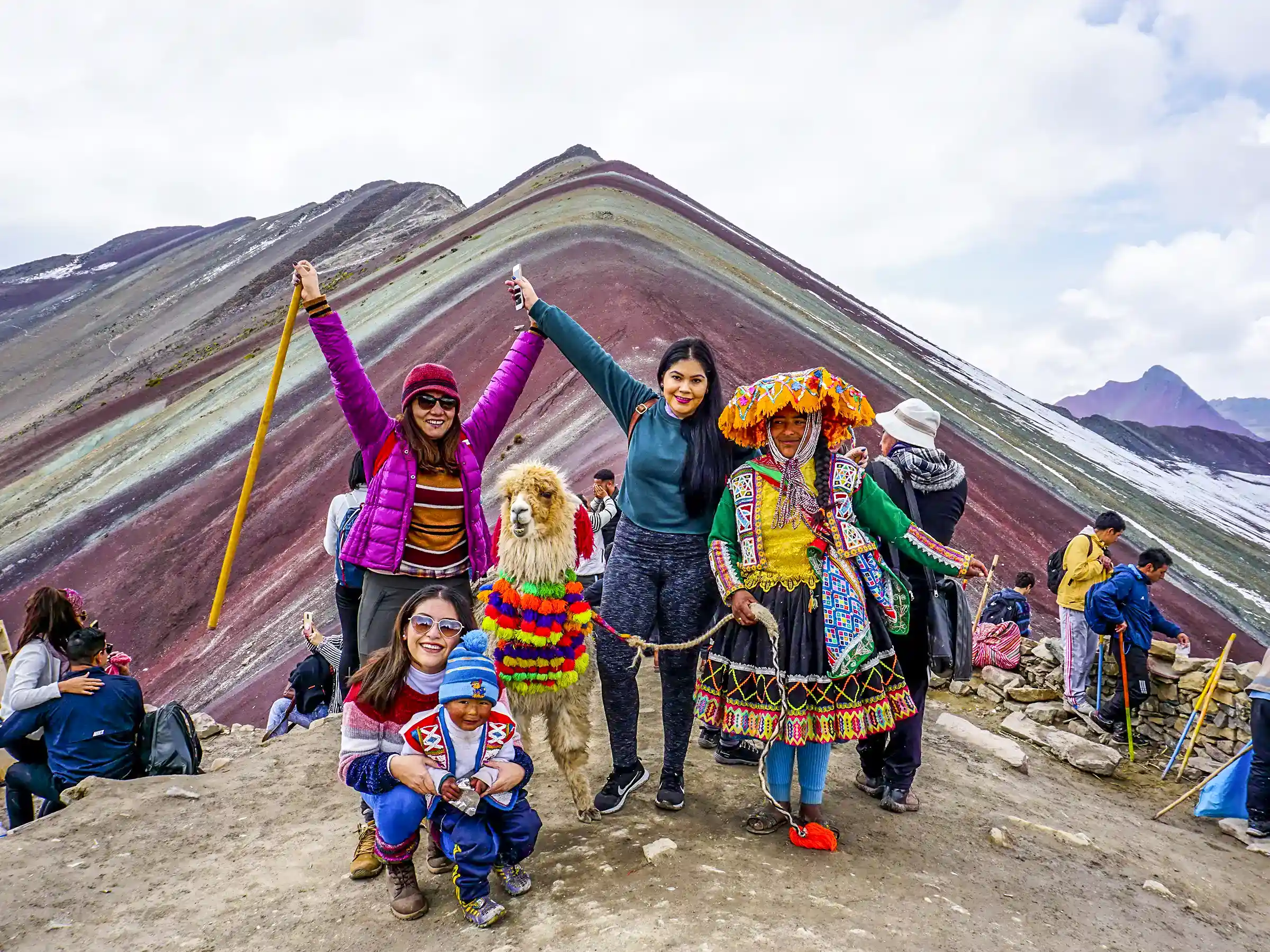
Until a few years ago, most people didn’t know about the existence of Rainbow Mountain Peru. It was in the year 2015 when it was discovered and only from the year 2016 they started offering day tours to visit it.
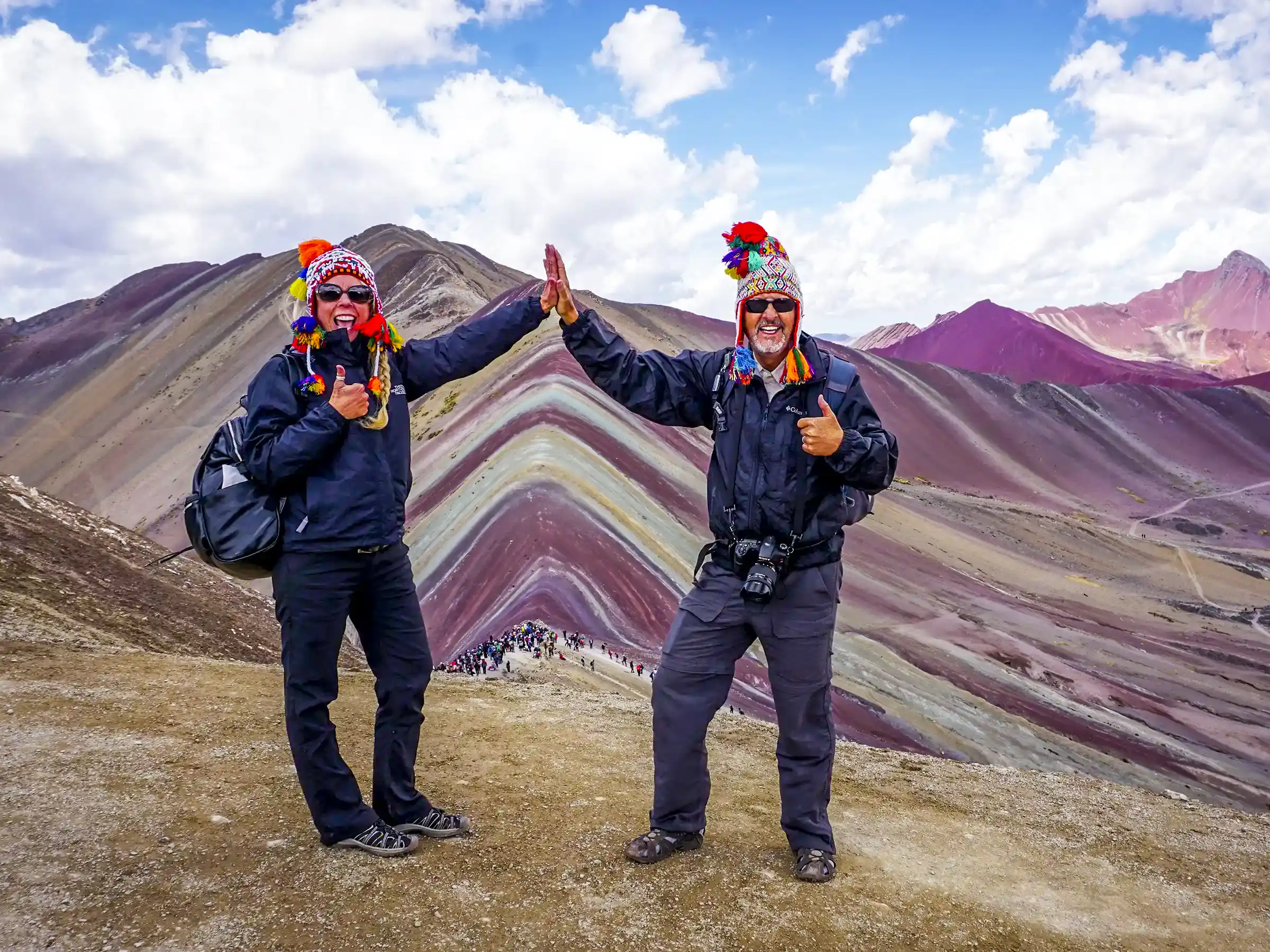
It’s hard to believe that not long ago no one knew about this place, but now Rainbow Mountain has become a very popular destination for hikers visiting Peru. No doubt, Instagram has contributed to its popularity and many backpackers flock to this full day tour from Cusco to take photos of its iconic rainbow colored capes in hues of yellow, red and orange.
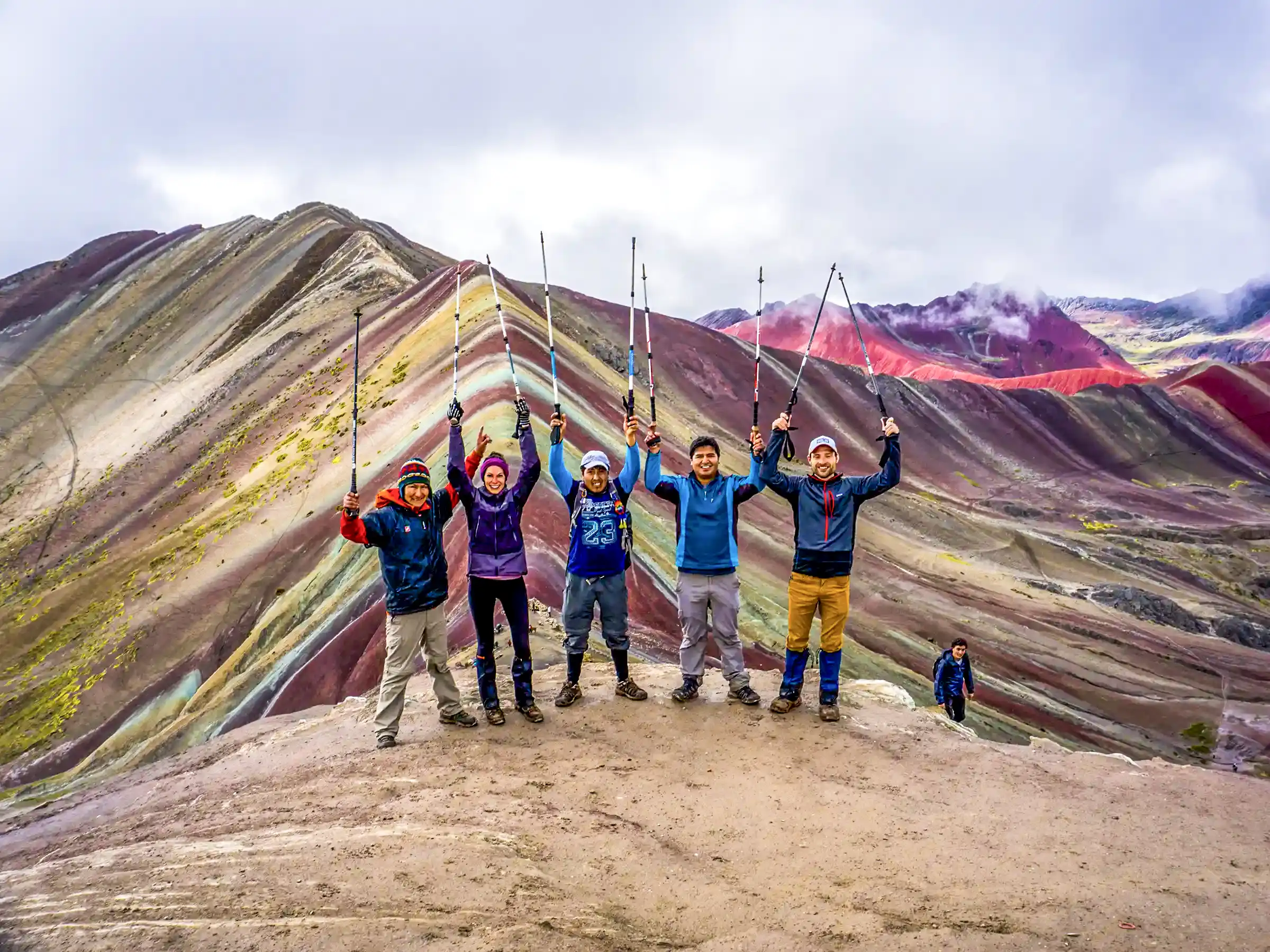
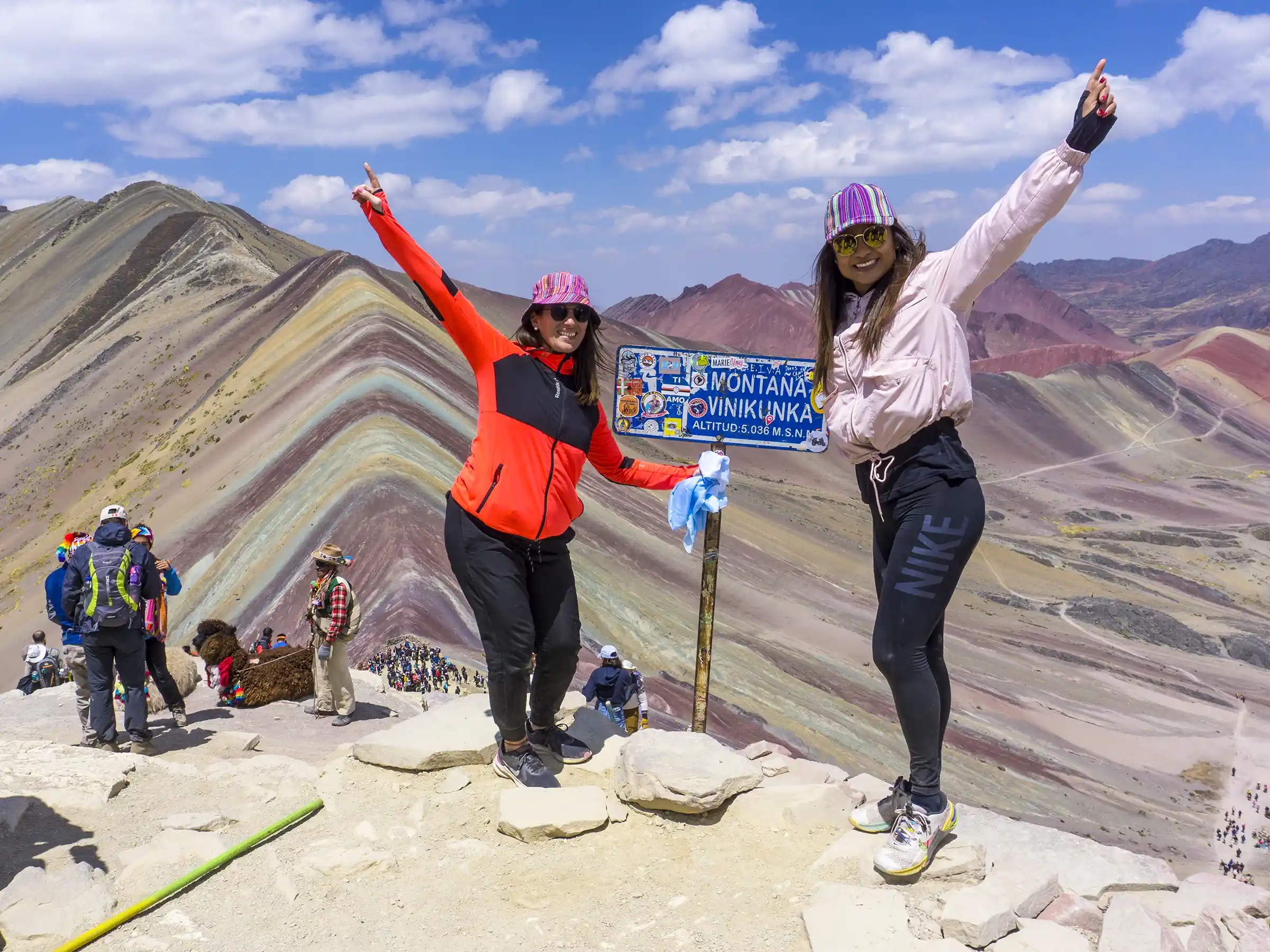
Rainbow Mountain, also known as Mountain Vinicunca or Mountain of Seven Colors, formed from melting ice and mixing with iron sulfide, oxide and other minerals in the soil, creating a rainbow-colored mountainous landscape. When the snow melted 5 years ago due to climate change, it instantly became one of the most picturesque places to visit in Peru.
General description of Vinicunca Rainbow Mountain Peru
Turquoise, scarlet and mustard-colored sediments extend through Rainbow Mountain, or Vinicunca, and give it its striking appearance. These different colored layers represent different mineral contents and were formed over millions of years before being exposed by tectonic movements and intense wind erosion in the high Andes. The mountain used to be covered by a glacier which has melted due to the effects of global warming. Subsequently, it became a popular excursion on the Ausangate Trek before shorter routes of 1 or 2 days were developed in recent years.
With an elevation of 5,200 meters above sea level (17,060 feet), Rainbow Mountain’s elevation is more than half that of Mount Everest. Those who wish to see this beautiful place for themselves should be prepared for a grueling 3-hour trek at great altitude. Weather conditions can also complicate travel, with extremely cold temperatures and intense UV rays due to elevation. But although getting there can be a bit tricky, the extraordinary view once you reach the top will make it worth it.
Difficulty: Moderate to difficult, depending on fitness level.
Rainbow Mountain Peru
All excursions to Rainbow Mountain depart from the city of Cusco, the ancient capital of the Inca Empire and the closest city to Machu Picchu and many of Peru’s most famous attractions. After leaving Cusco, your excursion will take you on a 2-hour journey south of the city to the village of Pitumarca. Not far from here is where you will find the Rainbow Mountain trail starting point to begin your hike.
History of Vinicunca
The story of how the mountain of colors was discovered is not very old. Earlier, snow covered the colorful lines of Vinicunca, however, due to climate change, the snow covering the hills melted slowly. Locals say the mountain was discovered in 2013 and since then, thousands of visitors who wish to have a glimpse of the multicolored mountain make the arduous trek to see the place.
Hike to Rainbow Mountain
The hike to Rainbow Mountain will generally take around 3 hours, depending on your speed and fitness level. The trail itself is mostly flat until the final ascent, but the great elevation is what makes it challenging. Due to the exertion that great altitude can cause on the body, it is generally recommended to walk at a relaxed pace (which anyway you will want to do in order to enjoy the natural beauty that surrounds you). For those who prefer not to hike, there are generally horses available to rent along the trail. However, they can only take you to the end of the flat part of the trail, where you will have to dismount and climb the final part on foot to reach the top.
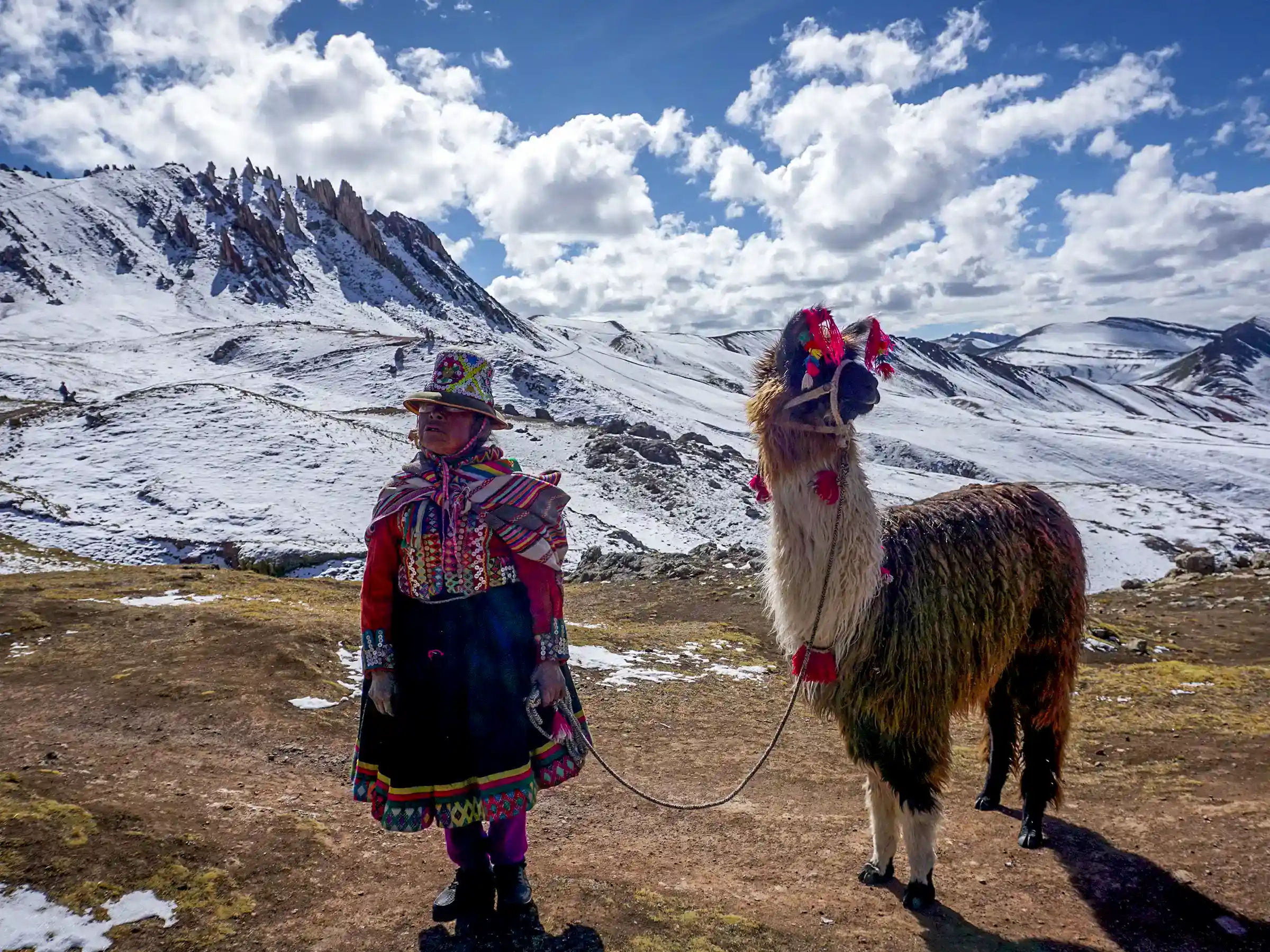
The local people surrounding Rainbow Mountain also raise herds of llamas and alpacas, so you will have the chance to see many of these adorable creatures along the way. Once you reach the summit lookout, you will have breathtaking panoramic views of not only Rainbow Mountain, but also the nearby Red Valley (some extended hikes also walk through the Red Valley itself via an alternative trail to the mountain).
Don’t forget to take lots of pictures of this incredible landscape! Around the mountain, you will also have the chance to see other rainbow hills. Thanks to the interesting geography and geology of the place, there are many colorful mountains, although Rainbow Mountain is the most picturesque.
When is the best time to visit Rainbow Mountain?
The Peruvian Andes are subject to two distinct seasons: the dry season, which lasts roughly from April to October, and the rainy season, which lasts from November to March (January and February being the months of highest precipitation). April and October are also nice, as they are generally transition periods between seasons.
Due to its high altitude and frigid air, the rainy season in the region often turns into snow at Rainbow Mountain. Visitors to Rainbow Mountain should come prepared with clothing for all types of weather, as conditions can also change rapidly. For more information on when to visit, be sure to consult our blog on the best time to visit Peru.
What to take to the 7-Colour Mountain tour:
A water bottle with enough water.
Snacks for the hike (be sure to take any junk with you). There are also locals selling candy, water, soft drinks and small snacks near the starting point of the trail.
Peruvian soles in lower denomination notes (S/.20 and S/.40) if you wish to pay for a horse ride.
Comfortable walking shoes with good traction.
A warm cap.
Multiple layers of clothing to be prepared/for all weather conditions.
Sunscreen and sunglasses. This is important not to forget, as the sun’s UV rays are very intense at high altitude.
A camera to capture all the beauty of the Mountain of the 7 colors (Rainbow Mountain).
Additional things you should bring to the Rainbow Mountain hike
Waterproof gear we had for hiking in Huayna Picchu (the stunning mountain right next to Machu Picchu).
Our cameras.
Water (2 liters per person).
Chocolates (and other appetizers).
Winter clothing: caps, fleece, sweaters, gloves, etc. (it gets cool in the morning, but warms up considerably in the afternoon).
Sunscreen and lip balm.
Toilet paper and wet wipes.
Any personal medication.
Shoes for hiking.
At what altitude is Rainbow Mountain? And what about the evil of height?
The possibility of experiencing altitude misconduct is one of the most common concerns for Rainbow Mountain visitors. The altitude evil is due to lack of oxygen at higher altitudes and can present at altitudes above 2,500 meters above sea level, which places the altitude of Rainbow Mountain at 5,200 meters, well above the minimum elevation where can occur.
Symptoms of altitude sickness (known as “soroche” in Peru) can include headache, vomiting, dizziness, fatigue and difficulty breathing. In rare cases, these symptoms can develop into more serious diseases. Due to the effort the heart makes with lower oxygen levels, people with a history of heart problems should not hike Rainbow Mountain. If you are unsure if you should hike Rainbow Mountain, be sure to discuss your concerns with a doctor before coming to Peru.
After you have discussed any health issues with your doctor and have decided that hiking Rainbow Mountain is safe for you, be sure to keep the following tips for your trip in mind:
Always take the necessary time to acclimate to the altitude for a day or two before attempting to hike Rainbow Mountain or undertake any other strenuous physical activity.
Check with your home doctor if there is any medication you can take to facilitate your acclimatization to high altitudes.
Drink coca tea, an herbal remedy for altitude sickness used by locals for thousands of years.
Avoid heavy meals, alcoholic beverages and smoking.
Be sure to keep well hydrated.
To get more information about height sickness and how to manage its symptoms, be sure to consult our blog on height sickness in Peru.
How to dress appropriately for the Rainbow Mountain hike
To dress appropriately at Rainbow Mountain, it is important to take into account temperature fluctuations due to altitude. Sometimes, during hiking, the sun can be extremely intense, which can cause skin burns.
Due to this, it is necessary to apply high protection sunscreen generously. However, even with intense sunshine, a light breeze can cause temperatures to drop quickly, turning cold. That’s why, it’s important to have a jacket or two on hand to keep warm.
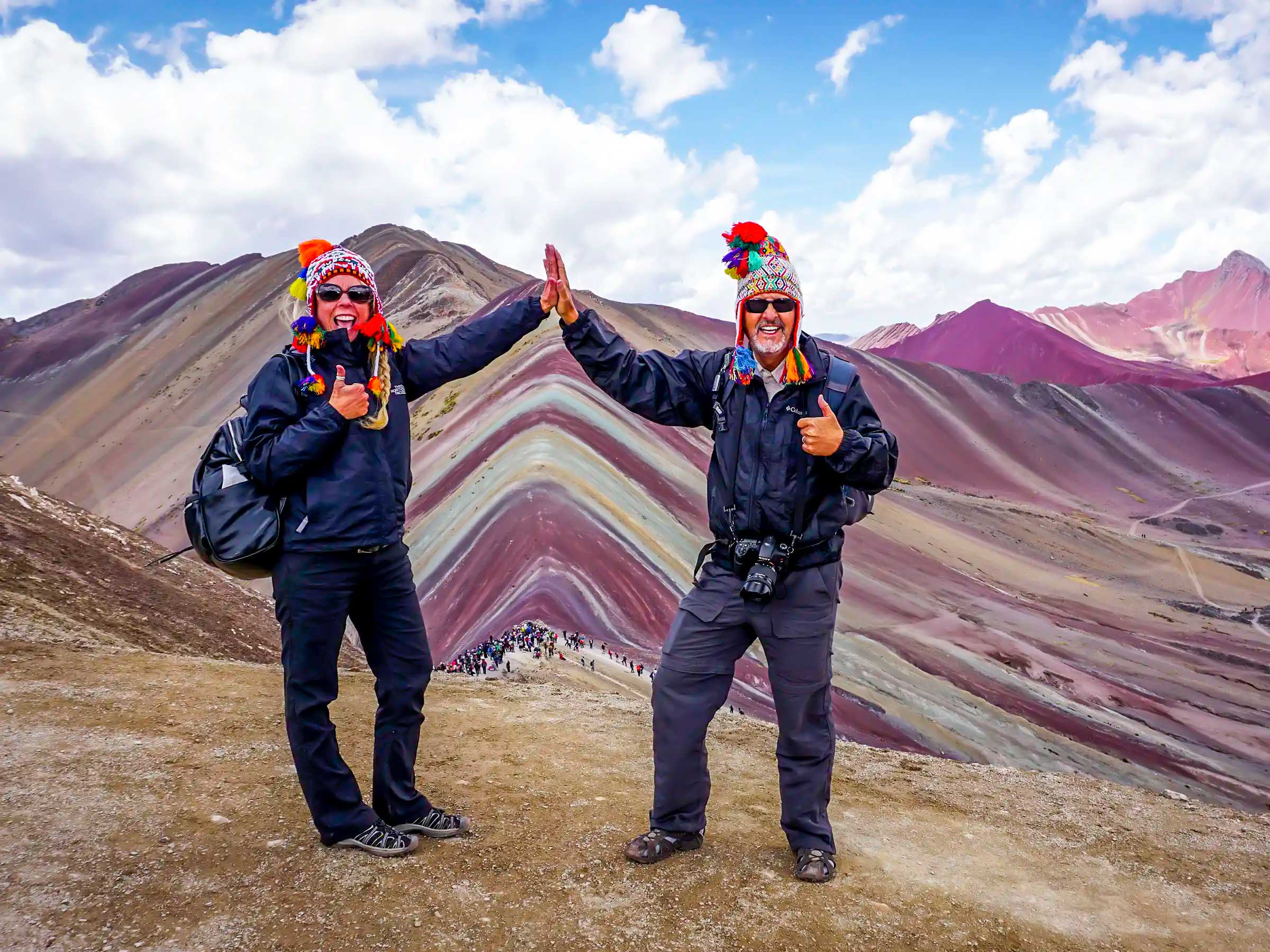
The key to dressing appropriately at Rainbow Mountain is to dress in layers. This will allow her to adjust her clothes according to temperature changes along the trek. You can start with a light t-shirt or blouse, then add a sweatshirt or light jacket and, if necessary, put a warmer jacket on top. It is also recommended to wear a cap and gloves to protect yourself from the cold.
In addition, wear comfortable and resilient hiking clothing, such as sport pants or leggings and hiking shoes with good grip. Don’t forget to bring enough water, lip balm and sunglasses to protect yourself from both the sun and dehydration.
In summary, the key is to dress in layers, be prepared to protect yourself from the intense sun and wear clothing that can be adjusted according to the changing temperature conditions at Rainbow Mountain.
Here are the essential items recommended to take with you:
Hiking shoes or comfortable boots. The sandals will not serve!
Windproof and waterproof jacket.
A base layer other than cotton.
A wide-brimmed hat.
Bottle of water.
A sweater or intermediate coat to wear on the lookout.
A small daypack to carry everything.
Being prepared for all types of weather is key to enjoying this hike. If you desire more tips, be sure to read our guide on how to dress in layers for the cold weather.
A horse can be rented
For the truly exhausted, there was another option. The vendors followed the group, kindly offering horseback rides to the top for only 70 soles ($20 USD) per person, only one way. If you decide to do this, make sure you choose a healthy horse.
I know this is the way the local indigenous community gets revenue, but it is also our responsibility to make sure it is done humanely. For me, hiring a horse would have been like letting the mountain win, so I went ahead.
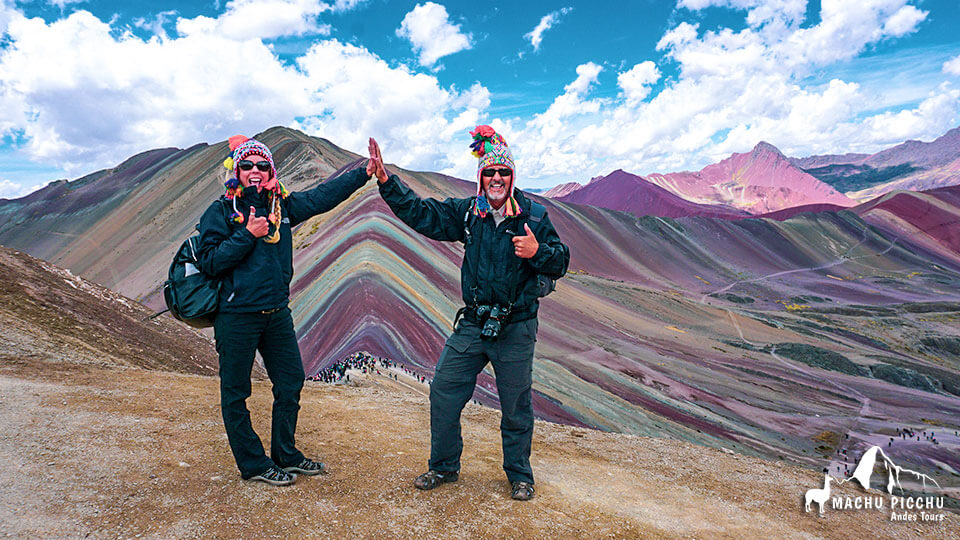
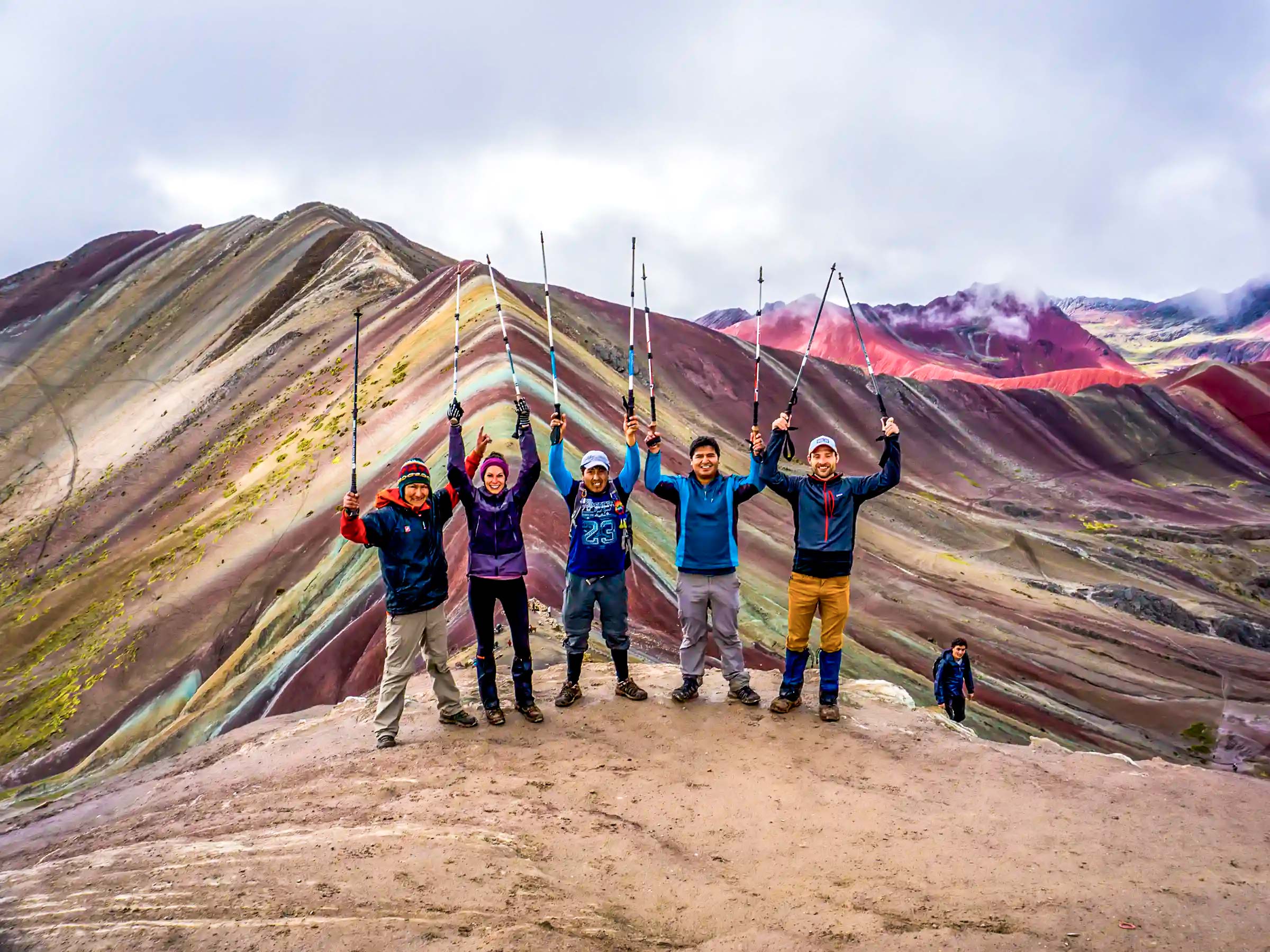
Rainbow Mountain is a slab of changing colors: pinks, greens, grays and yellows embedded in a bank of rock rising from the Earth. It is known as the Mountain of the Seven Colors for a good reason. You can see all the colors in layers, forming a rainbow pattern.
The best time to visit Seven Colors Mountain is generally during the dry season, which runs from March to November. This period offers a higher probability of good weather conditions. However, it is important to check the weather forecast before your visit, as unexpected rain can lead to unfavorable hiking conditions.
If rain is forecast and you have little time in the Cusco area, it may be recommended to omit the Seven Colors Mountain to avoid a tedious and unpleasant experience.
In terms of difficulty, scaling Seven Colors Mountain depends on your level of fitness and how acclimated you are to altitude. The hike is approximately 2.5 miles (4 km) one way, with a round trip of approximately 4.5-5 miles (7-8 km) and an ascent of around 3937 feet (1200 meters).
If you are already acclimatized and in good physical shape, the hike is not too difficult. Although it’s possible to get breathless and tired, most of the trail is relatively flat. The steep section begins in the last 1000 feet (300 meters) of ascent. Take your time, watch slowly and enjoy the views. The descent is usually easier and takes around 45 minutes to an hour.
It’s crucial to be prepared for altitude, as it can significantly affect your experience. The Seven Colors Mountain lookout is located at 17,060 feet (5200 meters) above sea level, and the hike starts around 13,779 feet (4200 meters). In comparison, the summit of Mount Kilimanjaro in Africa, which is significantly higher, takes several days to ascend.
Bad altitude is a real concern and many people have difficulties during this hike. It is essential to follow the advice to acclimate to the altitude in Cusco and make sure you are in good physical shape. Give yourself a few days to adjust to the elevation by exploring other attractions such as Machu Picchu and the Sacred Valley before attempting the hike to the Seven Colors Mountain. This will enhance your experience and make it more enjoyable.
Frequently asked questions
Below, you’ll find answers to some of the most frequently asked questions about hiking to Peru’s most colorful mountain.
HOW IS THE ROAD TO SEVEN COLORS MOUNTAIN?
The trail begins with a gradual and uniform incline through a valley until you reach a steeper climb towards Seven Colors Mountain.
To get the classic view, you must climb up a steep slope of compact, hard earth that faces the Mountain of the Seven Colors. Due to the slope being abrupt, the terrain can become slippery when wet. From the summit, you will be able to watch the colors glide down the mountain and enjoy stunning views of lush green landscapes fading into snowy mountain peaks.
HOW DIFFICULT IS THE HIKE TO SEVEN COLORS MOUNTAIN?
Many people don’t realize in advance that Seven Colors Mountain is a high altitude hike. The altitude, more than the incline of the trail, increases the challenge level of the hike. The starting point of the trail is located around 4,300 meters (14,000 feet) and reaches just over 5,000 meters (16,400 feet). Many people have difficulties and end up paying for a horse ride offered by one of the locals walking along the trail.
HOW IS THE CLIMATE?
The climate at Seven Colors Mountain is very unpredictable and changes with frequency and rapidity. You can experience a warm climate and clear skies one moment, and the next, overcast and snowy skies. The best thing is to make sure you are prepared for any weather by wearing layers of clothes.
ARE THERE BATHROOMS ALONG THE WAY?
There are very basic toilet facilities along the way. These bathrooms are very rustic, but are the only option available in such a remote area. Be sure to carry a roll of toilet paper with you, just in case.
DO YOU RECOMMEND A 1 OR 2 DAY TOUR?
A 1 day tour to the Seven Colors Mountain turns out to be a very long day. The pick-up in Cusco is very early, at 3 am, then there is a 3-hour journey to the starting point of the trail, and after several hours of walking, the return journey takes place.
This can be very exhausting even for those in excellent physical shape, so for those who have time, taking a 2-day tour can be a good idea. The itinerary of the 2 day tours is more slow and pleasant.
Not only does it split up the long round trip to Cusco, but camping closer to the Seven Colors Mountain allows you to better adapt to the altitude than in Cusco, which makes you feel better during the trek.
Why is the mountain of the seven colors in Peru colorful?
The mountain’s colors come from rich mineral deposits compressed into layers over millions of years. The red layers contain iron oxide, while the oxidized limoncello gives some layers a brown tone. The chlorite provides a greenish hue in other layers, and finally, iron sulphide is what makes the yellow layers of the Seven Colors Mountain yellow.
Tips for visitors:
Once you reach the base of Seven Colors Mountain, where most tourists take pictures, try climbing the hill behind the first viewpoint to have less crowded views.
Be sure to leave early to avoid the larger crowds; the earliest tours leave between 2am and 3am.
The weather at the top of Seven Colors Mountain can be unpredictable, so be sure to bring a windbreaker and sunscreen in case conditions change.
Feel free to rest and listen to your body while completing the hike. The height of the Mountain of the Seven Colors is above the altitude of Cusco.
How to get to Rainbow Mountain?
To reach the starting point of the Mountain of the Rainbow Trail in Qesoyuno, you must drive for three hours from Cusco. From there, you will start a trek that will take approximately three hours. Due to the difficult terrain and altitude, the hike is expected to be challenging, so traveling with a guide is recommended. If you don’t spend a few days in Cusco getting used to the altitude, you run the risk of suffering altitude sickness during the trek, which can be dangerous.
What is the best time to visit Rainbow Mountain?
The colors will present rain or make sun, but the photos you get on a sunny day will always be better, as the colors will look more defined under direct light. You can increase your chances of finding the mountain on a good day if you plan your trip during the warmer months, between November and March. During this period, it is less likely that there will be snow and rain, which also makes travel to the site easier.
How to get the best image of Rainbow Mountain?
While the mountain is undoubtedly beautiful, it rarely compares to the exaggerations seen online or in travel brochures. The colors will be much softer than the most popular social media posts
For the best photo, start your trek in the early hours of the morning or dusk. Not only will the temperatures be pleasant
What colors are found in the mountains of the Rainbow in Peru?
Pink: The mixture of red clay, clay and sand produces a beautiful smiling color.
White : This rich and clayey layer is rich in calcium carbonate like quartz and sandstone.
Greens and blues (turquoise): Iron and magnesium rocks and phyllites, a fine-grained metamorphic rock, are responsible for some of the most striking colors.
Creepy browns: eroded rocks and magnesium add depth to the color palette.
Yellows: Sandstones and limestones, enriched with sulfides, form striking gilt bands.
When was the Rainbow Mountain discovered in Peru?
The colors of the Mountain of the Rainbow in Peru were discovered about ten years ago; The exact date is unknown, but most agree it was between 2012 and 2015 when it caught international attention. Climate change caused more snow to melt in the high parts of the Peruvian Andes, revealing Vinicunca’s full color repertoire to the world.
The Mountain of the Rainbow is located at a very high altitude, approximately 5,200 meters above sea level, and is a three-hour drive southeast of Cusco. The lack of vegetation helps showcase their colors to the world.
Do people adore Peru’s Rainbow Mountain?
Vinicunca is located in the heart of Ausangate and Cusco.
Before climate change melted the snow, people carved ice from mountain glaciers and transported it for use in Cusco. Today, the inhabitants of the area offer offerings to the Apu and other mountains in the area.
The high altitude of the Rainbow Mountain means visitors should be prepared for the four seasons in a day and for any weather eventuality.
Morning and evening temperatures can drop rapidly below freezing point. Conditions can change quickly from a strong Andean sun to rain or snow.
The dry season is the best time to visit the Peruvian Andes. The months of April to October are the best, with clear and blue skies very likely. The intervening months of March and November can also be good. You can consult the weather forecast for more information.
December, January and February are the wettest months. In addition, you should be prepared for changing mountain weather, low clouds, rain and even snow, no matter when you visit. And most importantly, don’t forget sunscreen, as the Andean sun is strong.
Yes, it is necessary to properly acclimate to the altitude before visiting Peru’s Rainbow Mountain. This is due to the fact that the lookout is located at about 4,954 m above sea level, which is very high.
We recommend spending at least four nights in Cusco or a similar location just before visiting the mountain, ideally with excursions to altitudes higher than those in Cusco. Drink plenty of water, eat light meals, avoid caffeine and alcohol, and drink coca tea.
Every year, thousands of people from around the world come to Peru to hike the trail and see the ruins of the ancient Inca citadel. If you are thinking of embarking on this adventure, you will need to know some things.
This article will provide you with a general description of what you can expect on the Classic Inca Trail Peru, from the difficulty of the hike to the best time of year to do it.
Summary of the Inca Trail to Machu Picchu
This legendary trek to the Lost City of the Incas needs no introduction. The Inca Trail Peru is considered one of the best hikes in the world. It is a pilgrimage towards a holy city and a journey that can change your outlook on life. During the famous Inca Trail, not only are you hiking to see Machu Picchu, but wherever you stop to rest, you will have breathtaking views; you will also find several Inca sites full of history and mystery.
The journey to Machu Picchu begins in the cool, dry Andes, crosses the last mountains and plunges into the cloud forest, which is the beginning of the Amazon. This tour through different ecosystems allows the traveler to enjoy diverse landscapes, Inca ruins hidden in the dense jungle, paved trails, a huge variety of birds and endemic flowers.
What is the Famous Inca Trail?
The Famous Inca Trails are an extensive network of trails built by the Incas. These roads, known as the Qhapaq Nan or Inca Trail, were created to connect the vast territory of the empire and allow trade, communication, transportation of food and the movement of the Inca army.
The Inca empire, called Tawantinsuyo or “4 provinces of the sun,” originated in the Peruvian sierra in the early 13th century and extended until the arrival of the Spaniards in 1532. At its height, the empire included regions that today correspond to Colombia , Ecuador, Peru, Bolivia, Chile and Argentina. The capital of the empire was Cusco, an important city where the Inca kings resided.
From Cusco, the Inca Trails stretched in all directions: south, north, east and west. These roads were fundamental to the connectivity and logistics of the empire. In addition to facilitating trade and communication between the different regions, they also allowed for the transportation of food and the displacement of the Inca army.
The total length of the Inca Trails network is approximately 40,000 km (25,000 miles). This impressive network of trails has been recognized and declared a World Heritage Site by UNESCO due to its historical and cultural importance.
The Classic Inca Trail to Machu Picchu is just one small part of this vast network of trails in the Tawantinsuyo. With a length of 26 miles (42 kilometres), this trail was rediscovered in 1915 by American explorer Hiram Bingham. Machu Picchu, the ancient Inca city located in the mountains of the Peruvian Andes, became one of the most famous and visited destinations along the Inca Trail.
Why is the Classic Inca Trail so famous?
The Classic Inca Trail is one of the most stunning hikes in the world. It takes you through amazing scenery in Peru and culminates with a visit to the famous Machu Picchu.
During the height of the Inca Empire, the Classic Inca Trail was built. Inca engineers used advanced techniques and thousands of men to transport rocks and build paved roads and sacred archaeological sites. They even sculpted mountains to create trails and cities.
After the Spanish invasion in 1532, Manco Inca II, the rebellious Inca king, fled to Vilcabamba and destroyed all roads and bridges. There are many reasons why the Spaniards never found Machu Picchu and the Inca Trail.
For centuries, the Inca Trail and Machu Picchu remained lost, but they have been wonderfully preserved and now travelers can admire them.
In 1911, Hiram Bingham discovered Machu Picchu, and in 1915, he found the Inca Trail. These discoveries contributed to the Inca Trail trek becoming very popular.
The Inca Trail is only accessible on foot. It is a hike reserved for the porters of Peru, who are descendants of the ancient Chaskis, messengers who transmitted information. These porters are part of the hike experience.
The History of the Inca Trail to Machu Picchu
During the height of the Inca Empire in the 15th century:
The great Inca emperor, Pachacuti, built Machu Picchu and the Inca Trail.
In 1532:
The Spanish conquerors arrived in Peru and captured King Atahualpa in Cajamarca. The Inca king was executed.
In 1533:
The conqueror Francisco Pizarro arrived in Cusco and founded the city as a Spanish city on March 23,
On April 25, 1534, Pizarro founded the city of Jauja as the first capital of the new colony.
In 1535:
On Jan. 18, 1535, Pizarro founded the city of Lima on the central coast of Peru, known as “the city of kings.”
In 1536:
On May 6, the army of Manco Inca II began the siege of Cuzco against the Spanish conquerors led by Hernando Pizarro. The siege lasted nearly 10 months but was unsuccessful.
In January 1537:
Battle of Ollantaytambo between the troops of King Manco Inca and the Spanish expedition led by Hernando Pizarro. The Inca army defeats the Spaniards. However, Manco Inca’s forces abandoned Ollantaytambo and sought refuge in the jungles of Vilcabamba, where they established a small independent New Inca state until 1572. During the retreat, Manco Inca ordered the destruction of trails, bridges and villages to prevent the Spanish they would follow them.
In 1911:
Hiram Bingham, in search of Vilcabamba, accidentally discovered Machu Picchu. Until his death, he believed that Machu Picchu was Vilcabamba, the last capital of the Incas.
In 1915:
Hiram Bingham discovered the Inca Trail and conducted excavations at all Inca sites. He walked the Inca Trail in the opposite direction, starting at Machu Picchu and ending at the beginning of the Inca Trail.
In 1983:
Machu Picchu was declared World Heritage Site by UNESCO.
In 2007, it was chosen as one of the New Seven Wonders of the World.
In January 2020:
The Inca Trail was closed due to a landslide caused by excessive rains.
In March 2021:
After closure due to the COVID-19 pandemic, the Inca Trail reopened operating at 50% of its capacity.
In 2022:
The Inca Trail was completely open.
In 2023:
The Inca Trail is expected to be as busy as before the pandemic.
Salapunku: The first archaeological site after Km 82 is only visible from the other side of the river; Inca Trail hikers will not visit this site. Travelers can only take photographs from the other side of the river. The site has huge walls and a huge gate which is believed to be the entrance to Machu Picchu from the Sacred Valley.
K’anabamba: Also, Located on the opposite side of the Inca Trail River, this second archaeological site was a resting place for travelers.
Llaqtapata: “We found evidence that some Inca chief had built his house here and included ten or dozen buildings in the plan. They were made of coarse stones set in clay with the usual symmetrical arrangement of doors and niches. It may have been built by one.” of the Manco captains” – Hiram Bingham, The Lost City of the Incas, 1912.
Willkarakay: Located in the upper part of Llaqtapata , of circular construction and excellent location, it is noted that it was used and uninhabited by religious priests.
Runkurakay: Located at the heart of the Inca Trail, the semi-circular shaped ruins were once used as a rest stop for more messengers and a religious site for the moon.
Sayakmarca: It is an incredible archaeological site with a strategic location that controls all the valleys of the cloud forest below. This place was used for religious and military purposes.
Conchamarka: Located just below Sayacmarka , it was probably the home of an important person or a high priest.
Phuyupatamarca : “The city on the clouds” is located on top of a mountain above Mount Machu Picchu. This place was an important religious place because of the water and mountains.
Intipata: Located in the thick cloud forest, this site was an important agricultural center. The terraces adapt perfectly to the shape of the mountain.
Wiñayhuayna: This is one of the most beautiful and important Inca sites within the Inca Trail. A religious place with temples, water fountains and cultivation terraces.
Intipunku: Sungate , this incredible place, is a checkpoint and an astronomical observatory. The first and best view of Machu Picchu.
Machu Picchu: There is no greater joy than reaching Machu Picchu from the Inca Trail.
If you are planning to trek to Machu Picchu and it has been on your wish list, you should prepare adequately so as not to be surprised by the sudden changes in climate and different altitude zones. If you are a big hiking enthusiast, the Inca Trail to Machu Picchu is one of the best options; if it is exhausted, you can take the Salkantay Trek , Lares Trek , or any other alternative trek that will appeal to you. Not only will you enjoy the view, but the experience will be unforgettable. Below are some tips to make your hike a success.
Prevention of altitude sickness
If you’re one of the lucky few, you won’t feel anything. There are those whose hearts will beat harder while others may experience breathing difficulties. He may also have nausea or headache. Don’t take risks; you must prepare yourself for that if its your first time in this place.
The best thing you can do is give yourself at least two days to acclimate before trekking the Famous Inca Trail. Take some medicine, drink coke mate and sleep a lot. It would be best if you buy Diamox to use before you start walking.
No prescription needed to buy Diamox in Peru; you can find it in all pharmacies in Cusco; must order ACETAZOLAMIDE – Acetazolamide (brand name: Diamox), of course, is expected to feel some common side effects like dizziness, stupor, tingling sensation. It is best taken during the night before going to bed or early in the morning before your activities.
If you prefer something more natural, we recommend Sorojchi Pills, Altivital and coca mate, and drink plenty of water.
Physical preparation before the hike
Although it’s a lot of fun, it’s not that easy. You have to prepare physically and psychologically. It needs stamina and stamina, so if I could exercise to improve strength and breathing, it would be pretty easy. Consider running or other cardiovascular exercise. Other important tips include breathing deeply, taking small steps, staying positive and renting hiking poles.
Almost all hikes on the Cusco to Machu Picchu trips will include passing through places of great altitude of at least more than 4000 meters (13123 feet) before arriving in Peru, performing short hikes regularly once a week plus.
Packing for your trip to Machu Picchu
This is an important aspect of all trips. Take your time to decide what you will need to hike. The experience could be worse if you forget essential items. I guess he forgot to bring extra batteries for his camera. It means you won’t capture memorable moments. Always have portable chargers for electronic devices. Other important things to take are documents (insurance, passport and diary), dresser items, medications and enough footwear. The climate also keeps changing, so it is important to have several outfits for different weather conditions.
Are there short hikes near Hot Waters?
There are a couple of additional hikes in Machu Picchu Village or Agua Calientes; if you stay in the village before or after Machu Picchu, you can visit the following Places.
Local Museum of Machu Picchu
Located near the Puente Ruinas (The bridge to Machu Picchu), you can access this place by walking 20 minutes from Aguas Calientes, or if you finish Machu Picchu, you can ask the bus driver to drop you off. by the bridge There is a fee (7 $) to enter the museum.
The station of the Butterflies
Located on the way to Machu Picchu from Aguas Calientes. The butterfly station is located just 10 minutes from the village. Will be able to learn a lot of interesting data about the local butterflies and take photographs. There is a fee of 10 soles to enter this place.
The Gardens of Mandor
This beautiful place is located 1 hour walk from Aguas Calientes; you can see birds, orchids, waterfalls and Machu Picchu from below. To visit Mandor, you need at least 3 hours, which is best with a tour guide.
Putucusi
In addition to Huayna Picchu and Mount Machu Picchu, there is a third and steepest mountain called Putucusi. You do not need an entrance ticket to walk to Putucusi, but we recommend you go with a tour guide. You need at least 3 hours to complete this mountain and enjoy the incredible view of Machu Picchu from another mountain.
Climate on the Inca Trail Peru
The climate in the Andes is unpredictable. It can be enjoying a sunny day and in a matter of time it can turn rainy. The Inca Trail Peru lies in the Nuboso Forest, a warm, humid mountainous area that divides the frigid Andes with the dense Amazon. No matter the travel season, you should always be prepared for all seasons (sun, rain, wind, cold and even snow on Dead Women’s Pass).
When is the best time to do the Inca Trail to Machu Picchu?
The best time to hike the famous Inca Trail: many travelers ask this question frequently before deciding a final date: Peru has 2 seasons, wet and dry, you can hike the Inca Trail throughout the year except February, which is closed for maintenance.
The wet or rainy season runs from November to April. The average temperature during the day is 18 °C (64 °F), while the night temperature can round the 9 °C (48 °F).
The dry or winter season runs from May to October; the average temperature during the day is 16 °C (61 °F), while nights are much cooler, sometimes below 0 °C (32 °F).
Inca Trail in January
On average, January is the month with the most rainy days; however, touring the Inca Trail can be a beautiful experience. After the Christmas and New Year celebrations, the Inca Trail receives some visitors during January each year; this will make your trip memorable, as you will be hiking with some people.
Pros: Showers usually occur in the afternoon or for a couple of hours, and then the sun appears. This is the season of orchids, rainbows and spectacular prints with haze and clouds. The minimum temperature variation between day and night is from 19°C (66°F) during the day to 7°C (45°F) during the night.
Cons: landslides can affect the trail, delays on trains and flights.
Inca Trail in February
Inca Trail is closed all of February for maintenance; this month is the apogee of the rainy season. Machu Picchu is still open during February, and it is possible to do alternative treks such as Lares Trek, Quarry Trek and Huchuy Qosqo Trek. Other tours like Salkantay Trek are available. However, we strongly recommend not going to the Salkantay area during February due to the risk of heavy rains and landslides.
Inca Trail tours : Closed for maintenance
Salkantay Trek Tours : Not recommended
Choquequirao Tours : Not Recommended
Tours available during February: Lares Trek , Huchuy Qosqo Trek , Quarry Trek and Train Tour to Machu Picchu
Inca Trail in March
The Inca trails reopen this month and many travelers will go on excursion to Machu Picchu. March is still within the rainy season, but the weather will improve as the rains start to subside. It is also important to consider that the entire February Inca Trail has been closed for maintenance, and all campgrounds, trails, bridges and restrooms have been repaired and cleaned.
Pros: Clean campsites, bathrooms and new bridges. Semana Santa, or Semana Santa, is celebrated throughout Peru and Cusco with various celebrations. Temperature variations range between 17 ̊C/64 ̊ F during the day and 6° C/ 42° F during the night.
Disadvantages: landslides are still at risk, wet trails and campsites.
Inca Trail in April
The rainy season is over and there are even less crowds at Machu Picchu compared to the high season. During April, the trails are not as busy and the vegetation is still dense due to the rainy season, which offers excellent views. Before heading into winter, April is the best time to do the Inca Trail to Machu Picchu.
Pros: Warmer temperatures during the day, longer sunny hours, clear skies nights and night temperatures are not too cold. Temperature variations range between 19 ̊C/66 ̊ F during the day and 5° C/ 41° F during the night.
Cons: During Easter in Peru there can be a lot of people, and prices can increase in hotels and other places. We recommend booking in advance.
Inca Trail in May
May is the beginning of the dry season and also the high season for tourism in Machu Picchu. This means long queues for the buses at Machu Picchu and more people on the way. Despite the crowds, Mayo offers incredible views of the mountains during the hikes.
Pros: sunny days with clear sky nights offer excellent daytime and nighttime views. Temperature variations range between 19 ̊C/66 ̊ F during the day and 3° C/ 37° F during the night.
Disadvantages: Long queues for the buses to Machu Picchu, and it is necessary to book tours and hotels well in advance. The nights get colder.
Inca Trail in June
June is possibly one of the best months to visit Cusco and Machu Picchu. This peak of the high season comes accompanied by the biggest festival in Cusco, ” The fiesta del Inti Raymi Showers are sparse this month. However, you had better be prepared for rain and sun while hiking the Inca Trail.
Pros: sunny days with blue and clear skies offer gorgeous views of the hike. Temperature variations range between 19 ̊C/66 ̊ F during the day and 1° C/ 34° F during the night.
Cons: The crowds approach the maximum allowed per day, and the queue to enter the sites and buses is usually long. It would be best if you had sunscreen for the day times and good layers for the night.
Inca Trail in July
During the month of July the whole attraction in Cusco is massified, and in Machu Picchu we reach the maximum number of people allowed per day. The Inca Trail is dry and sunny and offers wonderful views of the scenery. The climate is very similar to June, with cooler nights.
Pros: sunny days with blue and clear skies offer gorgeous views of the hike. Temperature variations range between 19 ̊C/66 ̊ F during the day and 0° C/ 32° F during the night.
Disadvantages: The attractions are crowded. It is necessary to book hotels and excursions well in advance.
Inca Trail in August
August is the end of the high season; however, this is the vacation season in the northern hemisphere, and most Inca trails and sites will still have plenty of visitors. July, this month will bring many European and American travelers.
Pros: Sunny days with clear nights; however, unannounced showers can occur at any time during the Inca Trail. Showers can occur at any time, even during the driest months. August offers magnificent views during the hikes. Temperature variations range between 20 ̊C/68 ̊ F during the day and 3° C/ 37° F during the night.
Cons: crowds are still considered on all tours and Machu Picchu. Due to high demand, most hotels and tours remain the same as at the peak of the high season. Book your tours in advance.
Inca Trail in September
Although most days remain sunny and clear at the end of the dry season, rain chances increase and it is necessary to use a good rain gear. During September as well, temperatures will increase significantly, becoming warmer during the day and night.
Pros: the crowds have dwindled on the Inca Trail and Machu Picchu, and it’s the last month of the year to enjoy the hikes before the rainy season begins. The temperatures you will experience are 21 °C/69 °F and minimums of around 5 °C/41 °F.
Cons: rains can occur at any time and at night, and you should always be prepared with a good rain gear.
Inca Trail in October
However, with the onset of the rainy season, it will still enjoy sunny days with fewer visitors in October, making this month a perfect time to visit and enjoy the solitude of Machu Picchu and the Inca Trail. October is the best time to do the Inca Trail to Machu Picchu before the rainy season.
Pros: Good month to do the Inca Trail before the rains, less visitors on the Inca Trail. The temperatures you will experience are 21 °C/69 °F and minimums of around 5 °C/41 °F.
Cons: showers usually occur in the afternoon, so you should always wear a good rain gear.
Inca Trail in November
Hiking the Inca Trail in November can be wet and embarrassing, since it’s officially the rainy season; however, the showers do not last all day and there can be weeks without rain. In addition, there has been an increase in the climate from highs of 22° C/71° F and lows of around 7° C/44° F. Travelers will be able to enjoy the green landscapes of the blooming flora.
Pros: Less visitors and spectacular views of the mountains, the temperature is warmer, especially at night, with a significant variation comparing months like June or July.
Cons: hiking the Inca Trail can be rainy, which means wet and stuffy trails and campsites.
Inca Trail in December
Due to the holidays, December started with fewer visitors at the beginning of the month and ended with a lot of people at the end of the year. The Inca Trail offers excellent views while the vegetation flourishes: mist, rain, clouds and rainbows give this iconic hike a mysterious touch.
Pros: excellent views from the lush landscapes, warm climate of 22 °C/71 °F and minimum temperatures of around 6 °C/42 °F.
Cons: the campground and trails can be bumpy and wet, and the chances of landslides increase as we enter the heavy rain season.
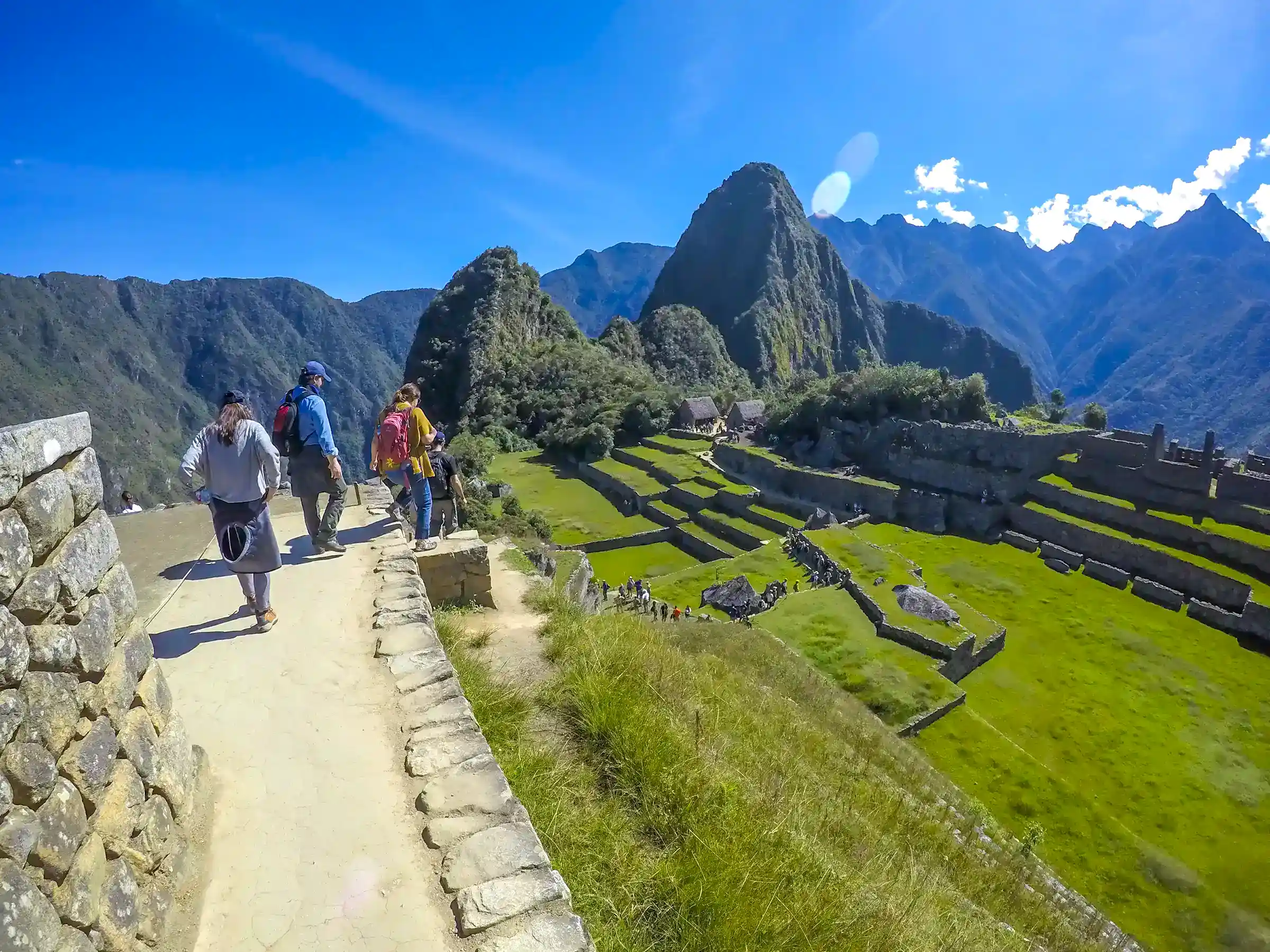
How difficult is the hike to Huayna Picchu?
There are some differences in difficulty between the short trail and the long trail. A reasonable level of moderate physical fitness is required if you are going to do the short trail and a higher level of physical fitness if you are doing the long trail. Both trails involve a considerable gain in elevation.
The short trail will require the use of hands and feet, as there is approximately a 60-degree elevation angle at its steepest point. The long trail will require a higher level of physical fitness than the short trail, as you will be hiking for a much longer period and the trail may be steeper in many parts. In addition, the long trail will require you to cross a wooden staircase to continue the tour.
What is the Elevation of Huayna Picchu?
The top of the Huayna Picchu trek is located at 8,924 feet or 2,720 meters above sea level. From the ruins of Machu Picchu, it climbs just over 1,000 feet. Huayna Picchu is located at an altitude higher than Machu Picchu. As mentioned earlier, it is a very steep climb. If you have a fear of heights or any condition that makes you lose your balance, such as vertigo, do not attempt this climb.
Altitude makes physical activity more difficult. The oxygen in the air is thinner, which requires you to breathe more intensely. This adds difficulty to this hike. As with any higher altitude trekking, it is important to make sure you are in good physical shape. This helps keep you properly oriented for the hike. Here you have a full breakdown of the altitude of Machu Picchu, or there are also some comparisons below.
Altitude comparisons:
Huayna Picchu: 8,924 feet (2,720 meters)
Machu Picchu: 7,971 feet (2,430 meters)
City of Cusco: 11,152 feet (3,339 meters)
What is the difference between Huayna Picchu and Mount Machu Picchu?
There is another lesser-known mountain to hike if you can’t get tickets for Huayna Picchu. The Machu Picchu Mountain, also known as Machu Picchu Hill, allows 400 people a day to make the ascent. The Machu Picchu Mountain is a slippery and more challenging trek, with a view that some say is much better than Huayna Picchu. Once at the top of the mountain, you have a panoramic view of many snow-covered mountains, as well as the citadel of Machu Picchu. The path to Mount Machu Picchu is composed mainly of granite steps.
The Machu Picchu Mountain is where the Incas discovered water, specifically underground springs. This was another important decision to build the citadel where they did. Huayna Picchu offers an aerial view of the mountain, and the Machu Picchu Mountain gave life to the resort.
What is the Temple of the Moon?
If you have time, we strongly recommend taking the longer trail at Huayna Picchu, as this will give you the opportunity to see the Temple of the Moon. The Moon Temple was discovered in 1936, 25 years after Hiram Bingham discovered Machu Picchu. The Moon Temple is an Inca ceremonial temple located in a cave.
In the center of the cave is a rock carved throne. No one is sure what the Temple of the Moon was used for. Some believe it was a royal tomb.
Another theory is that it was a place of worship for the gods, as the caves were thought to be an entrance for the gods towards a temple. Finally, another theory is that it was the center of a ceremonial bath complex.
Tickets for Mount Machu Picchu 2025
The alternative Mount Machu Picchu route will have 400 spaces per day, spread over 2 hours:
Check-in from 06:00 to 07:00 hrs.
Check-in from 07:00 to 08:00 hrs.
Check-in from 08:00 to 09:00 hrs.
Visitors with this type of entrance should directly enter the Machu Picchu Mountain route and leave the monument the same way. This type of entry will have the possibility to re-enter the city to perform circuit 3 (low short – yellow color).
The Huchuypicchu Mountain alternative route will have 200 spaces per day, distributed over 9 hours:
Check-in from 06:00 to 07:00 hrs.
Check-in from 07:00 to 08:00 hrs.
Check-in from 08:00 to 09:00 hrs.
Check-in from 09:00 to 10:00 hrs.
Admission from 10:00 to 11:00 hrs.
Check-in from 12:00 to 1:00 hrs.
Check-in from 1:00 to 2:00 hrs.
Check-in from 2:00 to 3:00 hrs.
Visitors accessing this alternate route must complete circuit 4 (low long – celestial color) and will not be able to re-enter the monument.
Tickets for Huchuy Picchu Mountain 2025 – New hiking route in Machu Picchu
Huchuy Picchu is the smallest peak of Machu Picchu and is located right next to Huayna Picchu. You can only climb this mountain with valid tickets to enter Huayna Picchu Mountain. The difference is that it is very small, the walk is much shorter and does not represent a particular challenge.
Here you have detailed information about Mount Machu Picchu:
Restrictions: Suitable for tourists of any age.
Elevation: 3,082 meters above sea level.
Distance of the tour: 2 kilometers, where you will ascend approximately 300 meters of altitude.
Location: In front of Huayna Picchu and on the left of the traditional road.
Trail description: Abundant vegetation, highlighting wild orchids. The wide trails will allow you to walk leisurely.
Access: From the Machu Picchu Complex, climb up to the lookout (Guardian’s House), continue to the turnoff indicated by a sign.
Number of visitors: 400 spaces per day.
Hiking time: 3 and a half hours (round trip).
Difficulty level: Moderate/high.
Archaeological attractions: None.
Flora and fauna: You will find a variety of orchids, butterflies and birds.
Advantages: Less steep trails, panoramic views of the Inca City and Mount Huayna Picchu.
Disadvantages: No archaeological remains. It’s hard to get to the top.
Frequently Asked Questions Inca Trail Peru
When should I make reservations for the Inca Trail in 2025?
Be sure to make reservations for the Inca Trail as far in advance as possible. The government has strictly limited the number of people allowed on the Inca Trail (permits are issued for approximately 200 hikers per day, plus 300 porters). Permits can run out 6 to 9 months early.
How fit should I be to participate in the Inca Trail guided tour?
The Inca Trail is a grueling 43 km (26 mile) trek through mountainous regions that involves walking for 5 to 7 hours at great altitude and over rugged terrain. The maximum altitude is 4200 m above sea level. The Inca Trail is a tough hike and you must be well prepared and healthy before you start it. Try to spend 2 or 3 days in Cusco (3400 m) before starting the trek. If you do not exercise regularly or have heart, respiratory, knee or back problems, do NOT consider doing the walk.
Are there any age restrictions for the Machu Picchu and Inca Trail tour?
Cachi Life, Inc does not accept reservations for children under 8 years of age and adults over 67 years of age. All under 18s must be accompanied by an adult. The additional half carrier service (6 kg) is included with the purchase. Hikers older than 64 should consult their doctor before doing the Inca Trail to verify they are fit to participate in the trek.
We request proof of medical consultation if you are over 64 years of age. We recommend that clients older than 64 years arrive in Cusco at least 3 days before starting the trek. We recommend that all clients over the age of 59 talk to their doctor in advance about the best way to plan the trek and also to make sure their travel insurance covers such adventure activities.
We do not accept bookings from hikers over 60 years of age traveling solo or group bookings in which all members of the group are over 64 years of age.
What type of meals do they offer?
We offer standard meals, as well as a vegetarian meal option. Be sure to indicate your food preferences to us when booking your tour. We do not offer vegan meals. Keep in mind that all meals are prepared using the same pots. We will do our best to wash utensils and kitchen utensils, but there may be contamination.
Dining options:
Standard (no dietary requirements, eat everything).
No red meat.
Without fish.
Lactose-free.
Gluten free.
Can I climb Huayna Picchu?
Huayna Picchu is the large mountain located in front of Machu Picchu. There is a narrow and steep trail that leads up to the top of the mountain, where there are also some interesting Inca ruins.
What is the cancellation policy for Inca Trail bookings?
Unfortunately, no refunds are offered within the 30 days prior to departure. The payment is used to acquire the trekking permit for the Inca Trail and reserve a space in the group. After acquiring the permit, we cannot change the trekking departure date or modify the name or passport number on the permit.
If you decide to cancel, we are unable to transfer your Inca Trail reservations to another client. Government regulations prevent us from filling your canceled space with another traveler, and the government will not reimburse or credit us for the cost of the permit.
What happens if trekking the Inca Trail to Machu Picchu closes?
During month of February, the Inca Trail is closed for maintenance, so reservations aren’t accepted at that time. During the rainy season, heavy rains can trigger landslides which can block part of the road or close some of the campsites. Typically, these partial road closures last only a few days, but can extend over several weeks or even months. In the event of such closures, Cachi Life, Inc will make every effort to find an alternative route to reach Machu Picchu. If we cannot offer a suitable alternative, we’ll have to cancel the trek and refund any payment less the costs already spent or committed to operate the trek. You’ll have to claim the remaining part through your travel insurance.
Do I need a passport for the Inca Trail to Machu Picchu tour?
A passport is required to book the Inca Trail. Make sure the passport number matches the number that was used to book the trek. You will not be allowed to make the booking if your passport expires in the next 6 months.
You must carry your passport on the trek or you will not be able to start. The government will not allow you to enter the road if you do not have your permit. If you lose your passport, you should get a replacement before the trek. This requires filing an application with a $25 processing fee to the Peruvian government.
You will have to submit photocopies of your old and new passport, along with the police report of the lost passport. However, the government may not accept the transfer to the new passport. As such, this is considered a last resort. If this happens, it will be considered a cancellation by the hiker and no refund will be made. Peru will not allow entry to any person whose passport expires within 6 months following the date of entry.
Can I do the Inca Trail tour with my friends/family?
Yes, and we encourage it! However, if your friends book later, it’s possible they won’t be guaranteed a permit with your group. Permits are issued in order of arrival. We recommend everyone in your group book the trek at the same time.
Can I have my own campaign store?
Yes. We charge $85 for this. If this is a request, check with your travel expert prior to departure.
What can I expect from my tour guide on the Machu Picchu and Inca Trail tour?
Our tour guides speak excellent English. We guarantee that your guide will be with you during the Inca Trail trekking. All our guides provide the highest level of service. Ask all you want and ask to see what you want. Our guides will tailor your experience on the Inca Trail to your needs! This is your journey!
Take advantage of this great opportunity to fulfill your dreams of knowing one of the wonders of the modern world. Machu Picchu, the lost city of the Incas, the main tourist attraction of Peru and Latin America is the main stopping point for all travelers in the world.
Heading 21
For the purchase of any of our tour packages that include visiting Machu Picchu, you have a discount of US$ 30.00 per person from any country in the world and US$ 50.00 per person from the countries belonging to the Andean Community (CAN) Peru, Colombia, Ecuador, and Bolivia.
Heading 22
NOTE. This offer applies to visit Machu Picchu until March 31, 2019.
Incluye: TV cable, WI-Fi, baños privados, desayuno americano-continental-buffet, Agua Caliente las 24 horas, guarda equipajes.
Hoteles 2 estrellas.
Cusco: Monasterio San Pedro, Emperador Plaza, Bozart. Machupicchu: Hatun Samay, Inka Tower, Terrazas Del Inca.
Incluye: TV cable, WI-Fi, baños privados, desayuno buffet, Agua Caliente las 24 horas, guarda equipajes, calefacción, caja de seguridad.
Hoteles 3 estrellas.
Cusco: Garcilaso I-II, Plaza San Francisco, San Agustín Internacional. Machupicchu: La Cabaña, Jaya, Andina Luxury.
Incluye: TV cable, WI-Fi, baños privados, desayuno buffet, secadora de cabello, guarda equipajes, calefacción, caja de seguridad.
Hoteles 4 estrellas.
Cusco: Sonesta, Xima, San Agustín Dorado y Plaza. Machupicchu: Tierra Viva, El Mapi, Casa Andina.
Incluye: : TV cable, WI-Fi, baños y tina, desayuno buffet, teléfono con discado directo nacional e internacional, guarda equipajes, calefacción, caja de seguridad
Hoteles de lujo 5 estrellas.
Cusco: Palacio del Inca Libertador, Aranwa Boutique. Machupicchu: Sumaq, Inkaterra.
Incluye: TV cable, WI-Fi, baños y tina, desayuno buffet, minibar, teléfono con discado directo nacional e internacional, guarda equipajes, calefacción, caja de seguridad.
[tabby title=”Tren Peru Rail” icon=”fa fa-train”]
Reservar Hoteles Trenes a Machu Picchu.
Tren Expedition
Vive la aventura de la travesía a Machu Picchu a un menor costo, en un tren con todas las comodidades a bordo, el tren Expedition es perfecto para lo que busca.
La decoración de los vagones estan con imágenes de la cultura andina y es la antesala perfecta para lo que será su visita a la ciudadela de Machu Picchu.
Además cuenta con personal altamente capacitado que será el encargado de atenderlo durante el viaje y ofrecerle una bebida fría o caliente y un snack con ingredientes andinos.
Las salidas son todos los días con diversidad de horarios y frecuencias.
Ruta: Desde Poroy (Cusco), Ollantaytambo a Machu Picchu.
Incluye.
Ida y Retorno: Servicio de Snack básico variado a elección.
Bebidas no alcoholicas calientes o frías a elección (una bebida caliente y otra fría por persona).
Servicio higienico solo en el tren y estaciones.
Horarios:
Desde Ollantaytambo a Machu Picchu Ida 6:10am y 7:45pm / Retorno 2:55 am, 6:20 pm y 8:50pm.
Desde Poroy Cusco a Machu Picchu ida 6:40 am / Retorno 3:20 pm
Tren Vistadome
Si es Usted un amante de la naturaleza y los paisajes, el tren Vistadome es su mejor opción.
Las ventanas panorámicas ubicadas en las paredes y techos de los vagones hacen que la conexión con el exterior se experimente de una manera muy vívida.
Además, en el viaje de retorno el Vistadome cuenta con un desfile de moda a bordo que le mostrará una exclusiva colección de baby alpaca con las últimas tendencias en prendas y un show de baile en vivo, todo ello inspirado en la cultura milenaria de los andes.
Incluye. Snack con ingredientes de la zona y Bebidas no alcohólicas para disfrutar a bordo.
Las salidas son todos los días con diversidad de horarios y frecuencias
Ruta: desde Poroy (Cusco), Ollantaytambo, Urubamba a Machu Picchu.
Horarios:
Desde Ollantaytambo a Machu Picchu. Ida 7:05am / Retorno 4:43 pm.
Desde Poroy Cusco a Machu Picchu. Ida 7:35 am / Retorno 4:43 pm.
Belmond Hiram Bingham
Viaje en un servicio personalizado, exclusivo y lujoso tren Belmond Hiram Bingham y disfrute del sofisticado coche comedor, del coche bar y del coche observatorio, desde donde podrá disfrutar al aire libre de la maravillosa ruta, en compañía de un cóctel peruano y de shows locales de música en vivo.
Inicie su experiencia con un cóctel de bienvenida. Una vez empezado el recorrido, el maître lo invitará a disfrutar de un brunch y un almuerzo gourmet. Y si su viaje es de retorno, disfrutará de una cena gastronómica. En ambos casos podrá acompañar con bebidas (no premium) y una excelente selección de vinos.
A ritmo de cajón peruano y panderetas, y durante tod
o el recorrido, un show único lo acompañará con música típica e internacional, enmarcando lo que será un viaje inolvidable a la ciudadela de Machu Picchu.
Ruta: desde Poroy (Cusco) a Machu Picchu Ida y Vuelta.
Horarios. Ida 9:50 am / Retorno 5:50 pm.
Incluye.
Show de bienvenida con danzas típicas de la región
Coche Bar con los mejores cócteles peruanos
Almuerzo gourmet a bordo
Coche Observatorio para disfrutar de los paisajes de la ruta
Show de música en vivo
Bus de subida hacia la ciudadela de Machu Picchu
Boleto de entrada a la ciudadela de Machu Picchu
Una guía turística en español y / o inglés para un grupo de hasta 14 personas.
Hora del té en el Hotel Belmond Sanctuary Lodge
Autobús de regreso a la ciudad de Machu Picchu
Salón VIP en la estación de Machu Picchu
Cena gourmet a bordo
[tabby title=”Tren Inka Rail” icon=”fa fa-train”]
Reservar Hoteles Trenes a Machu Picchu.
The Voyager Machu Picchu Train
Inicie su travesía disfrutando de cómodos asientos, de excelente servicio precios comodos. Deléitese del increíble paisaje que envuelve el camino a Machu Picchu entre picos nevados, imponentes montañas, río serpenteante y el cambio de vegetación hasta entrar en el mágico bosque húmedo que alberga la ciudadela Inca.
Incluye.
Cómodos asientos con mesas al frente para disfrutar del viaje
Amplias ventanas que permiten admirar toda la belleza del paisaje
Relajante música de fondo
Un excelente equipo humano que hará de su viaje la mejor experiencia
Deliciosa selección de bebidas frías y calientes, elaboradas con jugos de frutas y hierbas andinas.
Ruta. Desde Ollantaytambo – Machu picchu – Ollantaytambo.
Horarios. Ida 6:40am, 7:20am, 11:15am, 12:36pm, 4:36pm y 7:27pm. / Retorno 8:30am, 10:32am, 2:30pm, 4:12pm, 7:00pm y 9:30pm.
The 360° Machu Picchu Train
Experimente una forma única de viajar a Machu Picchu en el mejor tren panorámico de 360°
Explorando el paisaje andino como nunca con ventanas panorámicas más amplias y altas, y con un vagón observatorio al aire libre que incluye un bar. El único tren en Perú con una app de entretenimiento a bordo que te permitirá aprender más sobre el viaje en tren y la civilización Inca.
Incluye.
Cómodos y espaciosos asientos con mesas al frente.
Ventanas panorámicas más amplias.
Plataforma al aire libre con bar para admirar el paisaje.
Delicias gourmet y orgánicas elaboradas con productos del Valle Sagrado.
App de entretenimiento a bordo.
Ruta. Desde Poroy (Cusco) – Ollantaytambo – Machu Picchu ida y vuelta.
Horarios.
Desde Poroy a Machu Picchu. Ida 5:55 am / Retorno 4:12 pm.
Desde Ollantaytambo a Machu Picchu. Ida 7:22 am y 12:36 pm / Retorno 10:32am y 4:22 pm.
The First Class Machu Picchu Train
Viaje con máxima comodidad y espacio a bordo; deléitese del menú gourmet elaborado con ingredientes orgánicos y andinos como trucha, quinua, aguaymanto y una selección de vinos. Además, de un cóctel de bienvenida y una variedad de bebidas naturales frías y calientes.
El nuevo First Class cuenta con un coche Observatory-Lounge de lujo que ofrece música en vivo, bar y balcón donde podrá apreciar los más increíbles paisajes.
Incluye.
Cómodos asientos con mesas al frente para disfrutar del viaje
Amplias ventanas que permiten admirar toda la belleza del paisaje
Música en vivo
El Observatory–Lounge es un elegante salón finamente decorado, con cómodas butacas, amplios espacios y bar a bordo además cuenta con balcón (*)
Cóctel de bienvenida
Menú gourmet, elaborado con ingredientes andinos
Deliciosa selección de bebidas frías y calientes, elaboradas con jugos de frutas y hierbas oriundas
directions_bus Bus privado desde Machu Picchu Pueblo hacia la Ciudadela.
Ruta. Desde Ollantaytambo – Machu Picchu – Ollantaytambo.
Horarios. Ida. 11:15 am / Retorno 7:00 pm.
The Private Machu Picchu Train
Servicio Privado
Todo un coche solo para usted y sus acompañantes. Incluye champagne de bienvenida y el más exquisito menú de degustación acompañado con los mejores vinos de la región, además de bar libre con las mejores bebidas a su entera disposición. Un coche lleno de detalles que evocan todo el colorido y sabor de la cultura andina.
Caracteristicas
Bello salón finamente decorado, cómodas butacas, amplios espacios y bar a bordo
Amplias ventanas que permiten admirar toda la belleza del paisaje
Relajante música de fondo
Botella de champagne de bienvenida
Bar libre con las mejores bebidas
Delicioso menú de degustación elaborado con los más deliciosos y exóticos ingredientes locales, maridado con los mejores vinos de la región
Opera a pedido cualquier día del año
Ruta. Desde Ollantaytambo – Machu Picchu – Ollantaytambo.
Horarios. Ida 6:40 am, 11:15am y 4:36 pm / retornos. 8.30am, 2:30pm y 7:00pm.
Inca Trail tickets 2025 Famous Hike to Machu Picchu
Book your 2026 Inca Trail tickets now.
The Inca Trail that leads thousands of tourists every year to Machu Picchu is categorizing as one of the ten best treks in the world. Its amazing roads made of stone, impressive landscapes, the variety of microclimates and rich biodiversity make this stretch of the Inca Trail reach the category it has and unique in South America.
The ancient settlers of Peru and South America. They built more than 60 thousand kilometers hiking trails for their multiple uses. Therefore, Machupicchu Andes Tours focuses on the 4-day Classic Inca Trail, which starts at km 82 and also on the Short Inca Trail that begins at km 104 of the railroad to Machu Picchu.
Inca Trail tour 1-Day. Cusco – Ollantaytambo – Km 104 – Wiñaywayna – Machu Picchu – Cusco.
Inca Trail 2-day. Cusco – Ollantaytambo – Km 104 – Wiñaywayna – Aguas Calientes Town (spend the night) – Machu Picchu – Cusco.
There are regulations imposed by the Peruvian state that limit the Inca Trail traffic to 500 people per day, including guides, cooks, and porters who must carry all the camping equipment. The rules, do not allow pack animals on the Inca Trail, this for the conservation of the old stone road.
The percentage of support personnel for hikers is almost 75% of the people who enter per day, and due to the high tourist demand on the Inca Trail, the spaces allocated for hikers are quickly depleted. For this reason, if you want to walk along this incredible path, you must book at least 6 or 7 months in advance and through an authorized travel and tourism agency to operate the Inca Trail, such as Machupicchu Andes Tours.
How do I book my Inca Trail tickets 2026?
Booking the Inca Trail tickets with Machupicchu Andes Tours is very easy. Because we are available 24 hours a day, 7-day a week and you must provide us with the following information:
1.- First, choose three different dates: the first date should be the main one and two optional backup dates in case we cannot reserve your first option because it can be exhausted. But, this does not often happen, because the Machupicchu Andes Tours team works to obtain the first alternative.
Send us all the required information of each hiker of your group
Full name as it is registered in your passport.
Passport number
Birthdate
Nationality
Gender
In this case, send us the high-quality photo or scan of your passport, because any wrong or changes could invalidate your permit to enter the Inca Trail.
Dates to start your hike: please specify your first, second and third option of start dates of the Inca Trail trek
Phone number or WhatsApp and email
Deposit US$ 200 for each hiker, so we will be ready to reserve your Inca Trail permit for the date you chose. We have several payment methods: VISA, MASTER, AMERICAN EXPRESS and PAYPAL. After receiving your deposit, we will send you a confirmation email.
Once we have all your required information and the deposit, we will place your order on our reservation waiting list for the requested dates.
Note.
If you are in the process of renewing your passport, do not worry, send us your old passport information or your valid driver’s license and then update with your new correct passport number once you have it.
We recommend that you wait calmly with regard to the start dates of the trek and wait to make reservations for flights, hotels and other travel plans until your Inca Trail permit is 100% confirmed.
About changes to dates, information, cancellations, and refunds.
We can change typographical errors or if there is a new passport number. The rules imposed by the Peruvian government does not allow name changes and transfer of entry permits. It is personal, so it is very important that you bring your document with which you made your reservation the Inca Trail to be able to show at the control points.
Also, the Peruvian government does not allow changes of dates, cancellations, and reimbursements. Once we obtain the permit in your name and on the requested dates it is personal, it is 100% non-refundable and non-transferable. If you want to change the date, you must buy a new entry permit if it is available.
About the beginning of ticket sales for the Inca Trail.
The official sales of the Inca Trail Tickets 2026 opening, are made in October. Therefore, we must be ready to obtain your permission, and once we have your permission, we will send you an email with confirmation. Then, you can start to book your flights, hotels, etc.